Question
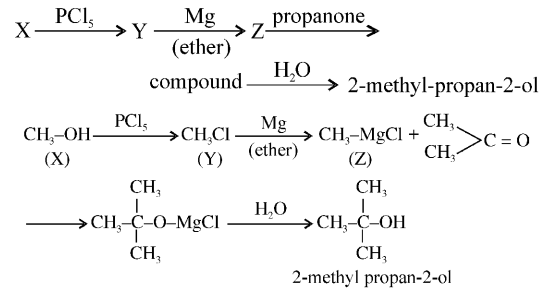
A compound $(X)$ reacts with $PCl_5$ to form compound $Y.$ Compound $Y$ reacts with ethereal solution of magnesium to form compound $(Z),$ which on treating with propanone and further hydrolysis to give $2-$Methyl propan$-2-ol. $ What are the compounds $X$ and $Y$ and also give the equations of the reactions.
Answer

The final product is $3^\circ$ alcohol of four carbon, which is obtained by reacting compound $Z$ with propanone. Therefore compound $Z$ is a carbon containing Grignard reagent, hence the starting compound will be a alcohol having one carbon. The reaction sequence will be as follows:
Image

Need a full question paper?

Generate a complete, print-ready paper with questions like this in minutes — across 16+ boards, with answer keys.

Start Generating Free

Similar questions

Define the following:
  1. Anionic detergents.
  2. Narrow spectrum antibiotics.
  3. Antacids.
A colourless inorganic salt A decomposes at about $250^\circ C$ to give only two products $B$ and $C$ leaving no residue. The oxide $C$ is a liquid at room temperature and is neutral to litmus paper while $B$ is neutral oxide. White phosphorus burns in excess of $B$ to produce strong dehydrating agent. Give balanced equations for above processes.
The conductivity of $0.001028 \mathrm{~mol} \mathrm{~L}^{-1}$ acetic acid is $4.95 \times 10^{-5} \mathrm{~S} \mathrm{~cm}^{-1}$. Calculate its dissociation constant $\Lambda_{\mathrm{m}}^{\circ}$ if for acetic acid is $390.5 \mathrm{~S} \mathrm{~cm}^2 \mathrm{~mol}^{-1}$.
After watching a programee on TV about the adverse effects of junk food and soft drink on the health of school children, Sonali, a student of class XII, discussed the issue with the school principal. Principal immediately instructed the canteen contractor to replace the fast food with the fibre and vitamins rich food like sprouts, salad, fruits etc. This decision was welcomed by the parents and the students.
After reading the above passage, answer the following questions:
  1. What values are expressed by Sonali and the principal of the school?
  2. Give two examples of water-soluble vitamins.
How would you achieve the following conversions:
  1. Nitrobenzene to aniline.
  2. An alkyl halide to a quaternary ammonium salt.
  3. Aniline to benzonitrile.
Write the chemical equation with reaction conditions in each case.
How would you account for the following:
  1. Among lanthanoids, Ln (III) compounds are predominant. However, occasionally in solutions or in solid compounds, $+2$ and $+4$ ions are also obtained.
  2. The $E^o_{M^{2+}/M}$ for copper is positive $(0.34V)$. Copper is the only metal in the first series of transition elements showing this behaviour.
  3. The metallic radii of the third $(5d)$ series of transition metals are nearly the same as those of the corresponding members of the second series.
How would you account for the following?
  1. Many of the transition elements are known to form interstitial compounds.
  2. The metallic radii of the third (5d) series of transition metals are virtually the same as those of the corresponding group members of the second (4d) series.
  3. Lanthanoids form primarily +3 ions, while the actinoids usually have higher oxidation states in their compounds, +4 or even +6 being typical.
Why does table salt, $NaCl,$ some times appear yellow in colour?
Define the following and give one example of each:
  1. Tranquillizers.
  2. Mordant.
  3. Hybrid rocket propellants.
Give reasons:
  1. $PCl_5$ is more covalent than $PCl_3.$
  2. $O-O$ bond has lower bond dissociation enthalpy than S-S bond.
  3. $F_2$ is a stronger oxidising agent than $Cl_{2}.$