Question
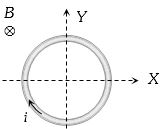
A conducting loop carrying a current $I$ is placed in a uniform magnetic field pointing into the plane of the paper as shown. The loop will have a tendency to
Answer

(b) Net force on a current carrying loop in uniform magnetic field is zero. Hence the loop can’t translate. So, options $(c)$ and $(d)$ are wrong.
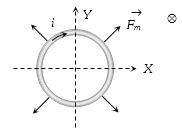
From Fleming's left hand rule we can see that if magnetic field is perpendicular to paper inwards and current in the loop is clockwise (as shown) the magnetic force $\overrightarrow {{F_m}} $ on each element of the loop is radially outwards, or the loops will have a tendency to expand.

Need a full question paper?

Generate a complete, print-ready paper with questions like this in minutes — across 16+ boards, with answer keys.
Start Generating Free

Similar questions

In a transformer, number of turns in the primary coil are $140$ and that in the secondary  coil are $280$. If current in primary is $4A$, then that in coil secondary is.....$A$
A tungsten body of diameter $2.3\, cm$ is at $2000\,^oC$. It radiates $30\%$ of the energy radiated by a black body of same radius and temperature. Find radius of black body which will radiate energy at same rate at the same temperature......... $cm$
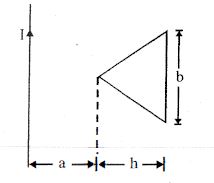
A very long straight conductor and isosceles triangular conductor lie in a plane and are separated from each other as shown in the figure. If $a = 10\ cm , b = 20\ cm$ and $h = 10\ cm$ , find the coefficient of mutuaI induction
A radioactive sample is $\alpha$-emitter with half life $138.6$ days is observed by a student to have $2000$ disintegration/sec. The number of radioactive nuclei for given activity are
Two open organ pipes of length $60 \mathrm{~cm}$ and $90 \mathrm{~cm}$ resonate at $6^{\text {th }}$ and $5^{\text {th }}$ harmonics respectively. The difference of frequencies for the given modes is . . . . . $\mathrm{Hz}$.

(Velocity of sound in air $=333 \mathrm{~m} / \mathrm{s}$ )
The length of the tube of a microscope is $10\, cm$. The focal lengths of the objective and eye lenses are $0.5\, cm$ and $1.0 \,cm$. The magnifying power of the microscope is about
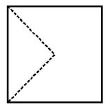
From the homogeneous square plate we cut a triangle (Figure). Side of the square is $a$ and. the apex of the triangle is at the center of the square. Distance fiom the center of the square to the center of mass of the remainder of the plate is
The breakdown in a reverse biased $p-n$ junction diode is more likely to occur due to
In an atomic bomb, the energy is released due to
$0.4\hat i + 0.8\hat j + c\hat k$ represents a unit vector when $c$ is