MCQ
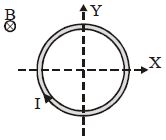
A conducting loop carrying a current $I$ is placed in a uniform magnetic field pointing into the plane of the paper as shown. The loop will have a tendency to
  • A
    Contract
  • Expand
  • C
    Move towards $+ve\, x-$ axis
  • D
    Move towards $-ve\, x-$ axis

Answer

Correct option: B.
Expand
b
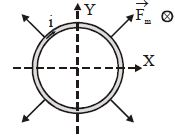
Net force on a current carrying loop in uniform magnetic field is zero. Hence the loop can't translate. So, options $(C)$ and $(D)$ are wrong From Fleming's left hand rule we can see that if magnetic field is perpendicular to paper inwards and current in the loop is clockwise (as shown) the magnetic force $\vec F_m$ on each element of the loop is radially outwards, or the loops will have a tendency to expand

Need a full question paper?

Generate a complete, print-ready paper with questions like this in minutes — across 16+ boards, with answer keys.
Start Generating Free

Similar questions

Select the correct statement : (Only force on a particle is due to electric field)
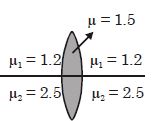
A thin lens of material having refractive index ${\mu}\, = \,1.5\,$ and focal length of $20\,\,cm$ in air has two mediums of different refractive indices ${\mu _1}\, = \,1.2\,$ and ${\mu _2}\, = \,2.5\,$ covering upper and lower halves of the lens, respectively as shown in figure. If an object is placed on the principal axis, then its two images will be formed one after refraction from upper part and other after refraction from lower part. Considering the object to be at $\infty ,$ the separation between two images formed would be......$cm$
In $X-$ ray tube when the accelerating voltage $V$ is halved, the difference between the wavelength of $K_{\alpha}$ line and minimum wavelength of continuous $X-$ ray spectrum
Those substances whose valence band and conduction band are almost in a state of overlap are :
In Young's double$-$slit experiment, the intensity of light at a point on the screen where the path difference is $\lambda$ is $k ( \lambda$ being the wavelength of light used$).$ The intensity at a point where the path difference is $\frac{\lambda}{4}$, will be
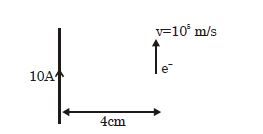
An $e^-$ is moving parallel to a long current carrying wire as shown. Force on electron is
The energy gaps $(E_g)$ between valence band and conduction band, for diamond, silicon and germanium are in the order
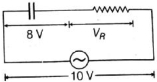
In a series $R$ $-$ $C$ circuit shown in figure, the applied voltage is $10\, V$ and the voltage across capacitor is found to be $8 \,V$. Then, the voltage across $R$ and the phase difference between current and the applied voltage will respectively be
$S_1$ and $S_2$ are two equipotential surfaces on which the potentials are not equal. Which of the statement is incorrect ?
 
Which of these relation holds good for an Ohmic conductor?