Question
A contract on constrution job specifies a penalty for delay of completion beyond a certain date as follows: $₹ 200$ for the first day, $₹ 250$ for the second day, $₹ 300$ for the third day, etc, the penalty for each succeeding day being $₹ 50$ more than for the preceding day. How much money the contractor has to pay as penalty, if he has delayed the work by $30$ days?
Answer

The penalty is given to be:
$Rs. 200$ for the first day,
$Rs. 250$ for the second day,
$Rs.300$ for the third day, etc
Since the penalty for each succeeding day is $Rs. 50$ more than for the preceding day,
The common difference = $Rs. 50$
Consider the work to be delayed for $30$ days.
$\text{S}_\text{n}=\frac{\text{n}}{2}\big[2\text{a}+(\text{n}-1)\text{d}$
$\Rightarrow\text{S}_\text{30}=\frac{\text{30}}{2}\big[2\text{(200)}+29\text{(50)}\big]$
$\Rightarrow\text{S}_\text{30}=15\big[400+1450\big]$
$\Rightarrow\text{S}_\text{30}=27750$
Hence, the contractor has to pay $Rs. 27750$ as penalty.

Need a full question paper?

Generate a complete, print-ready paper with questions like this in minutes — across 16+ boards, with answer keys.

Start Generating Free

Similar questions

A man observes a car from the to of a tower, which is moving towards the tower with a uniform speed. If the angle of depression of the car changes from $30^\circ $ to $45^\circ $ in $12$ minutes, find the time taken by the car now to reach the tower.
Show that the following points are the vertices of a square:
$P(0, -2), Q(3, 1), R(0, 4)$ and $S(-3, 1)$
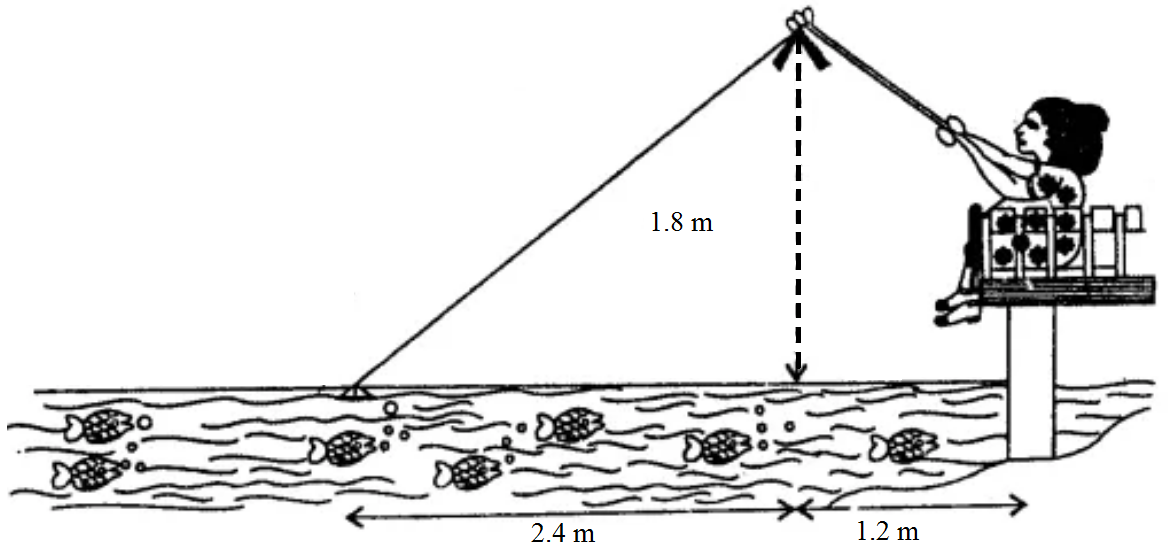
Nazima is fly Ashing in a stream. The tip of her Ashing rod is $1.8\ m$ above the surface of the water and the fly at the end of the string rests on the water $3.6\ m$ away and $2.4\ m$ from a point directly under the tip of the rod. Assuming that her string (from the tip of her rod to the fly) is taut, how much string does she have out? If she pulls the string at the rate of $5\ cm$ per second, what will the horizontal distance of the fly from her after $12$ seconds.
On dividing, $3 x^3+x^2+2 x+5$ by a polynomial g(x), the quotient and remainder are $3x - 5$ and $9x + 10$ respectively. Find $g(x)$
Hint: $\text{g}(\text{x})=\frac{(\text{3x}^3+\text{x}^2+\text{2x}+5)-(\text{9x}+10)}{(\text{3x}-5)}$
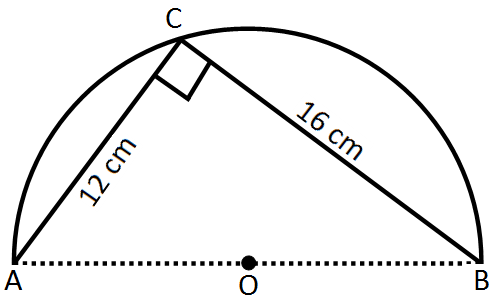
In the following figure, $O$ is the centre of a circular arc and $AOB$ is a straight line. Find the perimeter and the area of the shaded region correct to one decimal place. $\big(\text{Take }\pi=3.142\big)$
The sum of the areas of two squares is $640m^2$. If the difference in their perimeters be $64\ m$, find the sides of the two squares.
Solve the following systems of equations:
$\frac{2}{\sqrt{\text{x}}}+\frac{3}{\sqrt{\text{y}}}=2,$
$\frac{4}{\sqrt{\text{x}}}-\frac{9}{\sqrt{\text{y}}}=-1.$
Draw the graph of the equations $x = 3, x = 5$ and $2x - y - 4 = 0$. Also, find the area of the quadrilateral formed by the lines and the x-axis.
A toy is in the form of a cylinder with hemispherical ends. If e whole length of the toy is $90\ cm$ and its demeter is $42\ cm$, find the cost of painting the toy at the rate of $70$ paise per sq cm.
The sum of two numbers is $137$ and their difference is $43$. Find the numbers.