Question

A copper ring is held horizontally and a bar magnet is dropped through the ring with its length along the axis of the ring. The acceleration of the falling magnet while it is passing through the ring is

(a) Equal to that due to gravity

(b) Less than that due to gravity

(c) More than that due to gravity

(d) Depends on the diameter of the ring and the length of the magnet

Answer

(b) Less than that due to gravity

Need a full question paper?

Generate a complete, print-ready paper with questions like this in minutes — across 16+ boards, with answer keys.

Start Generating Free

Similar questions

A charge  exerts some force on a second charge . If third charge  is brought  near, the force of  exerted on

(a) Decreases

(b) Increases

(c) Remains unchanged

(d) Increases if  is of the same sign as  and decreases if  is of opposite sign

The rubber used in the wheels of aero-plane is _________?

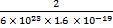
The Avogadro's number is 6  per gm mole and electronic charge is 1.6 . The Faraday's number is

(a)  

(b)  

(c)

(d)

Two parallel wires carry currents of 20A and 40A in opposite directions. Another wire carying a current anti parallel to 20A is placed midway between the two wires. T he magnetic force on it will be:
  1. Towards 20A.
  2. Towards 40A.
  3. Zero.
  4. Perpendicular to the plane of the currents.
To draw a maximum current from a combination of cells, how should the cells be grouped?
In broad-side-on position, the electric potential due to electric dipole is :

In the figure given below, the current passing through 6 Ω  resistor is

(a) 0.40 ampere

(b) 0.48 ampere

(c) 0.72 ampere

(d) 0.80 ampere

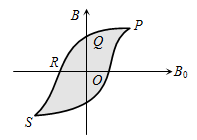
The figure illustrate how B, the flux density inside a sample of unmagnetised ferromagnetic material varies with B0, the magnetic flux density in which the sample is kept. For the sample to be suitable for making a permanent magnet

(a) OQ should be large, OR should be small

(b) OQ and OR should both be large

(c) OQ should be small and OR should be large

(d) OQ and OR should both be small

A person standing near the edge of the top of a building throws two balls A and B. The ball A is thrown vertically upward and B is thrown vertically downward with the same speed. The ball A hits the ground with a speed vA and the ball B hits the ground with a speed vB. We have:
  1. vA > vB
  2. vA < vB
  3. vA = vB
  4. The relation between vand vB depends on height of the building above the ground.

A conducting ring of radius 1 meter is placed in an uniform magnetic field B of 0.01Telsa oscillating with frequency 100Hz with its plane at right angles to B. What will be the induced electric field

(a) π volt/m

(b) 2 volt/m

(c) 10 volt/m

(d) 62 volt/m