A copper rod of cross-sectional area $A$ carries a uniform current $I$ through it. At temperature $T$, if the volume charge density of the rod is $\rho $, how long will the charges take to travel a distance $d$ ?
JEE MAIN 2018, Medium
Download our app for free and get started
Charge density
$\rho=\frac{\text { charge }}{\text { volume }}=\frac{q}{A d} \Rightarrow q=\rho A d$
Also, $q=I T \Rightarrow T=\frac{q}{I}=\frac{\rho A d}{I}$

Download our appand get started for free
Experience the future of education. Simply download our apps or reach out to us for more information. Let's shape the future of learning together!No signup needed.*
Similar Questions
- 1The temperature coefficient of resistance of tungsten is $4.5 \times 10^{-3}{ }^{\circ} C ^{-1}$ and that of germanium is $-5 \times 10^{-2}{ }^{\circ} C ^{-1}$. A tungsten wire of resistance $100 \,\Omega$ is connected in series with a germanium wire of resistance $R$. The value of $R$ for which the resistance of combination does not change with temperature is .......... $\Omega$View Solution
- 2The storage battery of a car has an $emf$ of $12\; V$. If the internal resistance of the battery is $0.4\; \Omega,$ what is the maximum current (in $A$) that can be drawn from the battery?View Solution
- 3In the given figure, the equivalent resistance between the points $A$ and $B$ is ............ $\Omega$View Solution
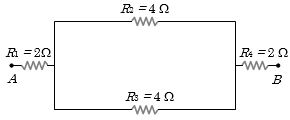
- 4In a typical Wheatstone network, the resistances in cyclic order are $A = 10 \,\Omega $, $B = 5 \,\Omega $, $C = 4 \,\Omega $ and $D = 4 \,\Omega $ for the bridge to be balancedView Solution
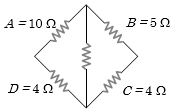
- 5If a wire is stretched to make it $0.1 \%$ longer, its resistance willView Solution
- 6Current of $4.8\,A$ is flowing through a conductor. The number of electrons per second will beView Solution
- 7View SolutionPick out the wrong statement
- 8In a potentiometer experiment, it is found that no current passes through the galvanometer when the terminals of the cell are connected across $52\ cm$ of the potentiometer wire. If the cell is shunted by a resistance of $ 5\,\Omega$, a balance is found when the cell is connected across $40\ cm$ of the wire. Find the internal resistance of the cell ........... $\Omega$View Solution
- 9In the given circuit calculate potential difference between $A$ and $B$ ............... $\mathrm{V}$View Solution
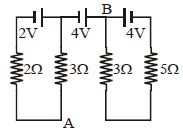
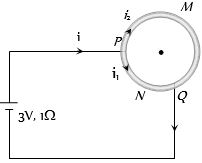
- 10A wire of resistance $10$ $\Omega$ is bent to form a circle. $P$ and $Q$ are points on the circumference of the circle dividing it into a quadrant and are connected to a Battery of $3\, V$ and internal resistance $1$ $\Omega$ as shown in the figure. The currents in the two parts of the circle areView Solution