MCQ
A copper salt is isomorphic with $ZnS{O_4}$, the salt will be
  • Paramagnetic
  • B
    Diamagnetic
  • C
    Ferromagnetic
  • D
    None

Answer

Correct option: A.
Paramagnetic
a
(a) $ZnS{O_4}\, \to \,Z{n^{ + 2 }} + SO_4^{ - 2}$

$Z{n^{ + 2 }} \approx \,C{u^{ + 2 }}$

$C{u^{ + 2}}\, \to \,3{d^9} - 1\,{\rm{unpaired}}\,\,\,{e^ - }$ paramagnetic in nature.

Need a full question paper?

Generate a complete, print-ready paper with questions like this in minutes — across 16+ boards, with answer keys.

Start Generating Free

Similar questions

The number of possible isomers of dichloronitrobenzene is
The following solutions were prepared by dissolving $10\, \mathrm{~g}$ of glucose $\left(\mathrm{C}_{6} \mathrm{H}_{12} \mathrm{O}_{6}\right)$ in $250 \,\mathrm{ml}$ of water $\left(\mathrm{P}_{1}\right)$, $10\, \mathrm{~g}$ of urea $\left(\mathrm{CH}_{4} \mathrm{~N}_{2} \mathrm{O}\right)$ in $250\, \mathrm{ml}$ of water $\left(\mathrm{P}_{2}\right)$ and $10\, \mathrm{~g}$ of sucrose $\left(\mathrm{C}_{12} \mathrm{H}_{22} \mathrm{O}_{11}\right)$ in $250\, \mathrm{ml}$ of water $\left(\mathrm{P}_{3}\right)$. The right option for the decreasing order of osmotic pressure of these solutions is :
Arrange following anions in decresing order of their stability

$\mathop C\limits^\Theta  {H_3},\mathop N\limits^\Theta  {H_2},\,\mathop O\limits^\Theta  H,\,\mathop C\limits^\Theta  l$

${C_2}{H_2}\,\xrightarrow[{excess}]{{C{H_3}MgBr}}\mathop {(A)}\limits_{salt} \,\, + \,\mathop {(B)}\limits_{hyydrocarbon} $

$(A)\,\xrightarrow[{excess}]{{Me\, - \,I}}\,(C)\,\xrightarrow[{(ii)\,\,{H^ + }}]{{(i)\,\,NaN{H_2}}}(D)$

What will be the $pH$ and $\alpha $ (degree of hydrolysis) respectively for the salt $BA$ of $0.1\, M$ concentration? (Given: $K_a$ for $HA = 10^{-6}$ and $K_b$ for $BOH = 10^{-6}$ )
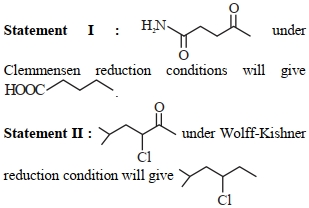
Given below are two statements :

In the light of the above statements, choose the correct answer from the options given below :
A solution is obtained by dissolving $ 12\,g$ of urea (mol.wt. $60$) in a litre of water. Another solution is obtained by dissolving $68.4\,g$ of cane sugar (mol.wt. $342$) in a litre of water at are the same temperature. The lowering of vapour pressure in the first solution is
"A" obtained by Ostwald's method involving air oxidation of $NH _3$, upon further air oxidation produces "B". "B" on hydration forms an oxoacid of Nitrogen along with evolution of "A". The oxoacid also produces "A" and gives positive brown ring test
Which of the following is a conjugated acid-base pair
In the following reaction; $xA \longrightarrow yB$

${\log _{10}}\,\left[ { - \frac{{d\left[ A \right]}}{{dt}}} \right] = {\log _{10}}\,\left[ {\frac{{d\left[ B \right]}}{{dt}}} \right] + 0.3010$

$‘A’$ and $‘B’$ respectively can be