A copper wire of length $1\, m$ and radius $1\, mm$ is joined in series with an iron wire of length $2\, m$ and radius $3\, mm$ and a current is passed through the wires. The ratio of the current density in the copper and iron wires is
Easy
Download our app for free and get started
(b) Current density $J = \frac{i}{A} = \frac{i}{{\pi {r^2}}}$ $ \Rightarrow $ $\frac{{{J_1}}}{{{J_2}}} = \frac{{{i_1}}}{{{i_2}}} \times \frac{{r_2^2}}{{r_1^2}}$
But the wires are in series, so they have the same current, hence ${i_1} = {i_2}$. So $\frac{{{J_1}}}{{{J_2}}} = \frac{{r_2^2}}{{r_1^2}} = 9:1$

Download our appand get started for free
Experience the future of education. Simply download our apps or reach out to us for more information. Let's shape the future of learning together!No signup needed.*
Similar Questions
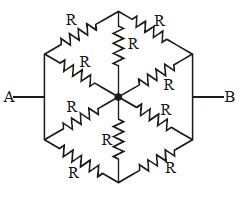
- 1Find out equivalent resistance between $A$ and $B$View Solution
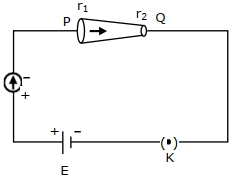
- 2In the given figure, a battery of emf $E$ is connnected across a conductor $P Q$ of length $'Y'$ and different area of cross-sections having radii $r_{1}$ and $r_{2}\left(r_{2}\,<\,r_{1}\right)$.View Solution
Choose the correct option as one moves from $P$ to $Q$ :
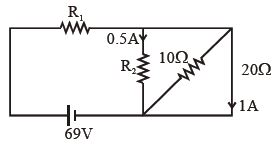
- 3In the circuit shown in the given figure the resistance $R_1$ and $R_2$ are respectivelyView Solution
- 4A $5\,^oC$ rise in temperature is observed in a conductor by passing a current. When the current is doubled the rise in temperature will be approximately ........... $^oC$View Solution
- 5View SolutionExpress which of the following setups can be used to verify Ohm’s law
- 6In an experiment to find $emf$ of a cell using potentiometer, the length of null point for a cell of emf $1.5\,V$ is found to be $60\,cm$. If this cell is replaced by another cell of $emf\; E$. the length-of null point increases by $40\,cm$. The value of $E$ is $\frac{x}{10} V$. The value of $x$ is $............$View Solution
- 7A cell can be balanced against $110\,\, cm$ and $100\,\, cm$ of potentiometer wire, respectively with and without being short circuited through a resistance of $10 \,\,\Omega$. Its internal resistance is ............... $\Omega$View Solution
- 8The potential drop across the $3$ $\Omega$ resistor is ............... $V$View Solution
- 9Water boils in an electric kettle in $20$ minutes after being switched on. Using the same main supply, the length of the heating element should be. . . . . . .to . . . . . .. times of its initial length if the water is to be boiled in $15$ minutes.View Solution
- 10Resistances $R_1$ and $R_2$ each $60\,\Omega$ are connected in series as shown in figure. The Potential difference between $A$ and $B$ is kept $120$ volt. Then what ............. $V$ will be the reading of voltmeter connected between the point $C$ and $D$ if resistance of voltmeter is $120\,\Omega .$View Solution