Question
(a) Copy and complete the following table which refers to two practical applications of electrolysis
  Anode Electrolyte Cathode
Silver plating of a spoon   A solution of potassium argentocyanide  
Purification of copper      
(iii) Extraction of sodium      
(b) Write the equation taking place at the anode for Q. 2(a).

Answer

(a)
  Anode Electrolyte Cathode
Silver plating of a spoon The plate of pure clean The solution of potassium argentocyanide Article to be electroplated
Purification of copper Impure copper The solution of copper sulphate and dilute sulphuric acid The thin strip of pure copper
(iii) Extraction of sodium Nickel Fused sodium chloride Iron
(b)
  1. $Ag - e^- → Ag^+$
  2. $Cu - e^-→ Cu^{2+}$
  3. $Cl^- - e^- → Cl$
  4. $Cl + Cl → Cl_2$

Need a full question paper?

Generate a complete, print-ready paper with questions like this in minutes — across 16+ boards, with answer keys.

Start Generating Free

Similar questions

Compare the process of calcination and roasting.
Explain electrolysis of lead bromide.
Calculate the volume of air at $\text{STP},$ required to convert $300 \ mL$ of sulphur dioxide to sulphur trioxide. Air contains $21\%$ of oxygen by volume.
How many atoms of each kind are present in the following molecules: calcium oxide, chlorine, water, carbon tetrachloride?
How many electrons are required by each atom mentioned in (a) to attain the nearest noble gas configuration?
$10.47\  g$ of a compound contained $6.25\ g$ of metal A and rest non-metal B. Calculate the empirical formula of the compound [At. wt of $A = 207, B = 35.5$]
Taking $MgCI_2$ as an electrovalent compound, $CCI_4$ as a covalent compound, give four differences between electrovalent and covalent compounds.
Two oxides of a metal $(M)$ have $20.12\%$ and $11.19\%$ oxygen. The formula of the first oxide is $MO$. Determine the formula of the second oxide.
How electrolysis can be used in extraction of aluminium? Why aluminium cannot be reduced by conventional reducing agents?
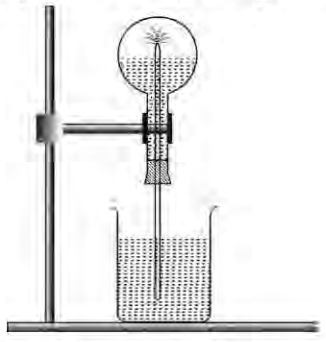
(a) The diagram shows a simple arrangement of the fountain experiment.
(i) Name the two gases you have studied which can be used in this experiment.
(ii) What is the common property demonstrated by this experiment?
Image
(b) Of the two gases, ammonia and hydrogen chloride, which is more dense? Name the method of collection of this gas.
(c) Give one example of a reaction between the above two gases which produces a solid compound.
State your observation for the following electrolytic reaction
Aqueous copper sulphate is electrolysed between copper electrodes.