MCQ
A couple is acting on a two particle systems. The resultant motion will be:
  • Purely rotational motion.
  • B
    Purely linear motion.
  • C
    Both $A$ and $B.$
  • D
    None of these.

Answer

Correct option: A.
Purely rotational motion.
A couple consists of two equal and opposite forces whose lines of action are parallel and laterally separated by the some distance.
Therefore, net force $($or resultant$)$ of a couple is null vector, hence there is no translational acceleration, only rotational motion will be there.

Need a full question paper?

Generate a complete, print-ready paper with questions like this in minutes — across 16+ boards, with answer keys.
Start Generating Free

Similar questions

The bulk modulus of copper is $1.4 × 10^{11}$ $Pa$ and the coefficient of linear expansion is $1.7 × 10^{-5} (C^o )^{-1}$. What hydrostatic pressure is necessary to prevent a copper block from expanding when its temperature is increased from $20^o C$ to $30^o C$
When a body is placed on a rough plane inclined at an angle $\theta $ to the horizontal, its acceleration is
The velocity of a bus, moving on a smooth road, is increased from $8\ m/ s$ to $32\ m/ s$ in $120s.$ During this process, the potential energy of the bus:
A heavy stone is thrown force a cliff of height h in a given direction. The speed with which it hits the ground?
A liquid can easily change its shape but a solid can not because.
A polyatomic ideal gas has $24$ vibrational modes. What is the value of $\gamma$ ?
A particle is executing $S.H.M.$ and its velocity $v$ is related to its position $(x)$ as $v^2+a x^2=b$, where $a$ and $b$ are positive constants. The frequency of oscillation of particle is ..........
A billiard ball is hit by a cue at a point distance $h$ above the centre. It acquires a linear velocity $v_0$. Let $m$ be the mass and $r$ be the radius of the ball. The angular velocity acquired by the ball is
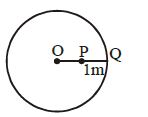
Two spheres $P$ and $Q$ of equal masses are attached to a string of length $2\,\, m$ as shown in figure. The string and the spheres are then whirled in a horizontal circle about $O$ at a constant rate. What is the value of the ratio
$\left( {\frac{{{\text{Tension in the string between P and Q}}}}{{{\text{Tension in the string between P and O}}}}} \right)?$
The magnitude of potential energy per unit mass of an object at the surface of earth is $E$, then the escape velocity of the object is ..........