MCQ
A couple produces
  • A
    Purely translational motion
  • Purely rotational motion
  • C
    Both translational and rotational motion
  • D
    no motion

Answer

Correct option: B.
Purely rotational motion
b
A couple produces rotation without translation

Need a full question paper?

Generate a complete, print-ready paper with questions like this in minutes — across 16+ boards, with answer keys.

Start Generating Free

Similar questions

A circular hole of diameter $R$ is cut from a disc of mass $M$ and radius $R ;$ the circumference of the cut passes through the centre of the disc . The moment of inertia of the remaining portion of the disc about an axis perpendicular to the disc and passing through its centre is
A body weighs $700\, gm$ weight on the surface of the earth. How much will it weigh on the surface of a planet whose mass is $\frac{1}{7}$ and radius is half that of the earth ...... $gm\, wt$
At a height of $10 \,km$ above the surface of earth, the value of acceleration due to gravity is the same as that of a particular depth below the surface of earth. Assuming uniform mass density for the earth, the depth is ............. $km$
The mean free path of gas molecules depends on $(d =$ molecular diameter$)$
A mass $m$ is suspended from the two coupled springs connected in series. The force constant for springs are ${K_1}$ and ${K_2}$. The time period of the suspended mass will be
A spring with spring constant k when stretched through $1\, cm$, the potential energy is $U$. If it is stretched by $4 \,cm.$ The potential energy will be
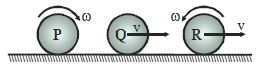
Three solid spheres are made to move on a rough horizontal surface. Sphere $P$ is given a spin and released. Sphere $Q$ is given a forward linear velocity. Sphere $R$ is given linear and rotational motions as shown in the figure. Directions of the friction force on spheres $P, Q, R$ are respectively
A tuning fork $A$ produces $4$ beats/sec with another tuning fork $B$ of frequency $320 Hz$. On filing the fork $A$, $4$ beats/sec are again heard. The frequency of fork $A$, after filing is ....$Hz$
An observer is moving towards the stationary source of sound, then
A particle $A$ is projected vertically upwards. Another identical particle $B$ is projected at an angle of $45^o $ . Both reach the same height. The ratio of the initial kinetic energy of $A$ to that of $B$ is