MCQ
A covalent bond is likely to be formed between two elements which
- ✓Have similar electronegativities
- BHave low ionization energies
- CHave low melting points
- DForm ions with a small charge
Two atoms with same electronegativity or similar electronegativity can form a covalent bond.
For example, $2 H$ atoms combine to form a covalent bond in hydrogen molecule.
Also, one $C$ atom combines with $4 H$ atoms to form four $C - H$ covalent bonds in methane.
Generate a complete, print-ready paper with questions like this in minutes — across 16+ boards, with answer keys.
$I_2 + 2e^-\to 2I^-$ ; $E^o = 0.54 \,V$
$MnO_4^-+ 8H^+ + 5e^-\to Mn^{2+} + 4H_2O$ ; $E^o = 1.52\, V$
$Fe^{3+} + e^-\to Fe^{2+}$ ; $E^o = 0.77\, V$
$Sn^{4+} + 2e^-\to Sn^{2+}$ ; $E^o = 0.1\, V$
The strongest reducant and oxidant respectively are :
$(i)\,\,(CH_3)_2CH - CH_2Br \xrightarrow{{{C_2}{H_5}OH}}$ $ (CH_3)_2CH - CH_2OC_2H_5 + HBr$
$(ii)\,\,(CH_3)_2CH - CH_2Br \xrightarrow{{{C_2}{H_5}O^-}} $ $(CH_3)_2CH - CH_2OC_2H_5 + Br^-$
The mechanisms of reactions $(i)$ and $(ii)$ are respectively
| LIST-I | LIST-II | ||
| A. | Glucose //NaHCO_(3)//Delta | I. | Gluconic acid |
| B. | Glucose/ HNO_(3) | II. | No reaction |
| C. | Glucose //HI//Delta | III. | n-hexane |
| D. | Glucose // Bromine water] | IV. | Saccharic acid |
Product $(B)$ is
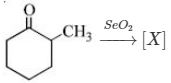
Compound $(B)$ is