MCQ
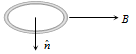
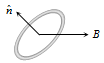
A current carrying loop is placed in a uniform magnetic field in four different orientations$\text{, I,II, III IV}$ arrange them in the decreasing order of potential Energy
$(a)$$(b)$  $(c)$  $(d)$
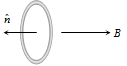
  • A
    $\text{I > III > II > IV}$
  • B
    $\text{I > II >III > IV}$
  • $\text{I > IV > II > III}$
  • D
    $\text{III > IV > I > II}$

Answer

Correct option: C.
$\text{I > IV > II > III}$

Need a full question paper?

Generate a complete, print-ready paper with questions like this in minutes — across 16+ boards, with answer keys.

Start Generating Free

Similar questions

Consider the following two statements:
  1. Linear momentum of the system remains constant.
  2. Centre of mass of the system remains at rest.
  1. ​​​​​​A implies B and B implies A.
  2. A does not imply B and B does not imply A.
  3. A implies B but B does not imply A.
  4. B implies A but A does not imply B.
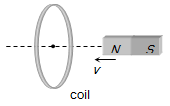
In the following figure, the magnet is moved towards the coil with a speed $v$ and induced $emf$ is $e.$ If magnet and coil recede away from one another each moving with speed $v,$ the induced $emf$ in the coil will be
A circular coil of n turns is kept in a uniform magnetic field such that the plane of the coil is perpendicular to the field. The magnetic flux associated with the coil is now $\phi$ . Now the coil is opened and made into another circular coil of twice the radius of the previous coil and kept in the same field such that the plane of the coil is perpendicular to the field. The magnetic flux associated with this coil now is:
The speed of an electron having a wavelength of $10^{-10} \mathrm{~m}$ is
If no external voltage is applied across P-N junction, there would be(a) No electric field across the junction (b) An electric field pointing from N-type to P-type side across the junction(c) An electric field pointing from P-type to N-type side across the junction(d) A temporary electric field during formation of P-N junction that would subsequently disappear


The production of e.m.f. by maintaining a difference of temperature between the two junctions of two different metals is known as(a) Joule effect(b) Seebeck effect(c) Peltier effect(d) Thomson effect
       
$C^{14}$ has half life $5700$ years. At the end of $11400$ years, the actual amount left is
Two identical parallel plate capacitors are connected in series to a battery of 100 V. A dielectric slab of dielectric constant 4.0 is inserted between the plates of second capacitor.  The potential difference across the capacitors will now be respectively(a) 50 V, 50 V(b) 80 V, 20 V(c) 20 V, 80 V(d) 75 V, 25 V
       
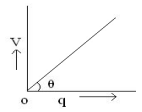
For an isolated object, the graph between potential and charge is given below. The capacity of an object is-
Image
When wavelength of incident photon is decreased then(a) Velocity of emitted photo-electron decreases(b) Velocity of emitted photoelectron increases(c) Velocity of photoelectron do not charge(d) Photo electric current increases