MCQ
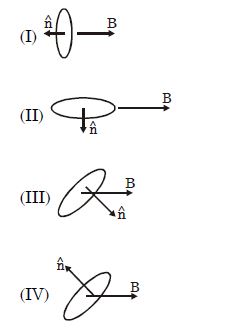
A current carrying loop is placed in a uniform magnetic field in four different orientations; $I,\, II,\, III$ and $IV,$ arrange them in the decreasing order of potential energy
  • A
    $I > III > II > IV$
  • B
    $I > II > III > IV$
  • $I > IV > II > III$
  • D
    $III > IV > I > II$

Answer

Correct option: C.
$I > IV > II > III$
c
$U = \, - \vec M.\vec B =  - MB\cos \theta $

Need a full question paper?

Generate a complete, print-ready paper with questions like this in minutes — across 16+ boards, with answer keys.

Start Generating Free

Similar questions

A body is thrown horizontally from the top of a tower of height $5 \,m$. It touches the ground at a distance of $10 \,m$ from the foot of the tower. The initial velocity of the body is ......... $ms^{-1}$ ($g = 10\, ms^{-2}$)
The displacement of a body in $8\,s$ starting from rest with an acceleration of $20\,cm / s ^2$ is $............$
A black body radiates $ 20\,W$ at temperature ${227^o}C$. If temperature of the black body is changed to ${727^o}C$ then its radiating power will be ..... $W$
The Young's modulus of a steel wire of length $6\,m$ and cross-sectional area $3\,mm ^2$, is $2 \times 11^{11}\,N / m ^2$. The wire is suspended from its support on a given planet. A block of mass $4\,kg$ is attached to the free end of the wire. The acceleration due to gravity on the planet is $\frac{1}{4}$ of its value on the earth. The elongation of wire is  (Take $g$ on the earth $=10$ $\left.m / s ^2\right):$
The energy band gap of $Si$ is........$eV$
A solid sphere and a hollow cylinder roll up without slipping on same inclined plane with same initial speed $v$. The sphere and the cylinder reaches upto maximum heights $h_1$ and $h_2$, respectively, above the initial level. The ratio $h_1: h_2$ is $\frac{n}{10}$. The value of $\mathrm{n}$ is__________.
From a solid sphere of mass $M$ and radius $R$ a cube of maximum possible volume is cut. Moment of inertia of cube about an axis passing through its center and perpendicular to one of its faces is
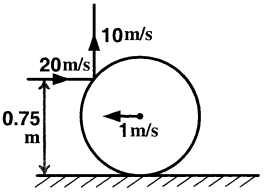
A thin ring of mass $2 \ kg$ and radius $0.5 \ m$ is rolling without slipping on a horizontal plane with velocity $1 \ m / s$. A small ball of mass $0.1 \ kg$, moving with velocity $20 \ m / s$ in the opposite direction, hits the ring at a height of $0.75 \ m$ and goes vertically up with velocity $10 \ m / s$. Immediately after the collision

$(A)$ the ring has pure rotation about its stationary $CM$.

$(B)$ the ring comes to a complete stop.

$(C)$ friction between the ring and the ground is to the left.

$(D)$ there is no friction between the ring and the ground.

Consider a satellite going round the earth in an orbit. Which of the following statements is wrong
The minimum intensity of light to be detected by human eye is ${10^{ - 10}}W/{m^2}$. The number of photons of wavelength $5.6 \times {10^{ - 7}}m$ entering the eye, with pupil area ${10^{ - 6}}{m^2}$, per second for vision will be nearly