MCQ
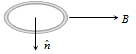
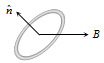
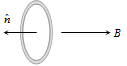
A current carrying loop is placed in a uniform magnetic field in four different orientations, I,II, III & IV arrange them in the decreasing order of potential Energy
(a)(b) (c) (d)
  • A
    I > III > II > IV
  • B
    I > II >III > IV
  • I > IV > II > III
  • D
    III > IV > I > II

Answer

Correct option: C.
I > IV > II > III
(c) I > IV > II > III

Need a full question paper?

Generate a complete, print-ready paper with questions like this in minutes — across 16+ boards, with answer keys.

Start Generating Free

Similar questions

The electric field of light wave is given as $\vec E\, = \,{10^{ - 3}}\,\cos \,\,\left( {\frac{{2\pi x}}{{5 \times {{10}^{ - 7}}}} - 2\pi  \times 6 \times {{10}^{14}}t} \right)\hat x\frac{N}{C}$. This light falls on a metal plate of work function $2\,eV.$ The stopping potential of the photoelectrons is ................ $V$
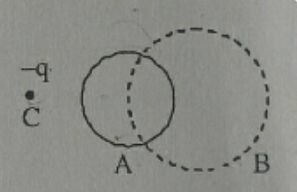
In the figure shown here, A is a conducting sphere and $B$ is a closed spherical surface. If a-q change is placed at $C$ near $A$, then the electric flux through the closed surface is -
The device, which can be used to detect whether an object is charged, is:
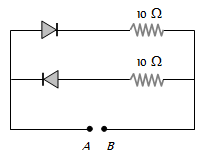
A 2V battery is connected across the points A and B as shown in the figure given below. Assuming that the resistance of each diode is zero in forward bias and infinity in reverse bias, the current supplied by the battery when its positive terminal is connected to A is
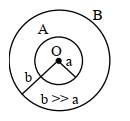
Two conducting circular loops $A $and $B$ are placed in the same plane with their centres coinciding as shown in figure. The mutual inductance between them $1$s:
An air bubble in a glass slab with refractive index $1.5$ (near normal incidence) is $5\,\, cm$ deep when viewed from one surface and $3\,\, cm$ deep when viewed from the opposite face. The thickness (in $cm$) of the slab is
Fermi level of energy of an intrinsic semiconductor lies
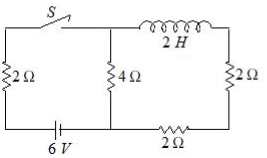
For the given circuit the current through battery of $6\,V$ just after closing the switch ' $S$ ' will be$.......A$.
The magnetic moment of a bar magnet is thus $...A...$ to the magnetic moment of an equivalent solenoid that produces the same magnetic field. Here, $A$ refers to.
The work functions of Caesium $(Cs)$,Potassium $(K)$ and Sodium $(Na)$ are $2.14\,eV,2.30\,eV$ and $2.75\,eV$ respectively. If incident electromagnetic radiation has an incident energy of $2.20\, eV$, which of these photosensitive surfaces may emit photoelectrons?