MCQ
A current carrying small loop behaves like a small magnet. If $A$ be its area and $M$ its magnetic moment, the current in the loop will be
  • $M/A$
  • B
    $A/M$
  • C
    $MA$
  • D
    ${A^2}M$

Answer

Correct option: A.
$M/A$
a
(a) $M = iA \Rightarrow i = M/A$

Need a full question paper?

Generate a complete, print-ready paper with questions like this in minutes — across 16+ boards, with answer keys.
Start Generating Free

Similar questions

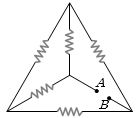
In the network shown in the figure, each of the resistance is equal to $2\,\Omega $. The resistance between the points $A$ and $B$ is .............. $\Omega$
Fraunhofer lines are produced by
The amplification factor of a triode is $18$ and its plate resistance is $8 ×10^{3}$. A load resistance of $10^{4} \Omega$ is connected in the plate circuit. The voltage gain will be
Two metal spheres of capacitance ${C_1}$ and ${C_2}$ carry some charges. They are put in contact and then separated. The final charges ${Q_1}$ and ${Q_2}$ on them will satisfy
Two resistors of $6\,\Omega $ and $9\,\Omega $ are connected in series to a $120\, volt$ source. The power consumed by the $6\,\Omega $ resistor is ........... $W$
Two radioactive nuclei $A$ and $B$ both convert into a stable nucleus $C$. At time $t = 0$ nuclei of $A$ are $4N_0$ and that of $B$ are $N_0$. Half life of $A$ is $1\, min$ and that of $B$ is $2\, min$. initially number of nuclei of $C$ are zero. At what time rate of disintegrations of $A$ and $B$ are equal .......... $min$
If the shift of wavelength of light emitted by a star is towards violet, then this shows that star is
Which of the following in a hydrogen atom is independent of the principal quantum number n?$ ($The symbols have their usual meanings$).$
When a beam of accelerated electrons hits a target, a continuous $X-$ ray spectrum is emitted from the target. Which of the following wavelength is absent in the $X-$ ray spectrum, if the $X-$ ray tube is operating at $40,000$ volts........$\mathop A\limits^o $
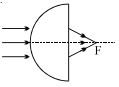
$A$ paraxial beam is incident on a glass $(n = 1.5)$ hemisphere of radius $R = 6\, cm$ in air as shown. The distance of point of convergence $F$ from the plane surface of hemisphere is......$cm$