MCQ
A current of $0.25\,A$ is passed through $CuS{O_4}$ solution placed in voltameter for $45 $ minutes. The amount of $Cu$  deposited on cathode is ............. $\mathrm{g}$ (At weight of $Cu = 63.6$)
  • A
    $0.22$
  • $0.20$
  • C
    $0.25$
  • D
    $0.30$

Answer

Correct option: B.
$0.20$
b
Given :-

Time $=45 min =45 \times 60 sec =2700\,sec$

Current$=0.25\,A$

$C u^{2+}+2 e^{-} \rightarrow C u$

At.weight of $Cu =63.6$ Electricity passed $=45 \times 60 \times 0.25=675\, C$ electricity deposit copper $=x \times 2 \times 96500\, C$ of electricity will $M=Z \times I \times T$

$x=0.20 \,g$

Need a full question paper?

Generate a complete, print-ready paper with questions like this in minutes — across 16+ boards, with answer keys.

Start Generating Free

Similar questions

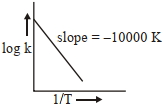
For the reaction, $aA + bB \rightarrow cC + dD ,$ the plot of log $k$ vs $\frac{1}{ T }$ is given below

The temperature at which the rate constant of the reaction is $10^{-4} s ^{-1}$ is .............. $K$.

(Rounded-off to the nearest integer)

[Given: The rate constant of the reaction is $10^{-5} s ^{-1}$ at $500 K$.]
Because of lanthanoid contraction, which of the following pairs of elements have nearly same atomic radii ? (Numbers in the parenthesis are atomic numbers)
Tribasic acid is
An elementary reaction between $A$ and $B$ is a second order reaction. Which of the following rate equations must be correct?
Assuming $1\,\mu\,g$ of trace radioactive element $X$ with a half life of $30$ years is absorbed by a growing tree. The amount of $X$ remaining in the tree after $100$ years is $\times 10^{-1}\,\mu\,g$ $[ Given : \ln 10=2.303 ; \log 2=0.30]$
Assertion : Phenol on oxidation with $KMnO_4$ gives meso-tartaric acid.
Reason : Pure phenol is colourless but turns pink due to oxidation to phenoquinone.
Which of the following is most basic
Dichromate ion is treated with base, the oxidation number of $Cr$ in the product formed is .... .
Which of the following ions does not liberate hydrogen gas on reaction with dilute acids ?
A reaction of $0.1$ mole of Benzylamine with bromomethane gave $23\, g$ of Benzyl trimethyl ammonium bromide. The number of moles of bromomethane consumed in this reaction are $n \times 10^{-1},$ when $n =\ldots...$ (Round off to the Nearest Integer).

(Given : Atomic masses: $C$ : $12.0\, u$, $H : 1.0\, u , N : 14.0\, u , Br : 80.0\, u ]$