MCQ
$A$ current of $(2.5 \pm 0.05)$ $A$ flows through a wire and develops a potential difference of $(10 \pm 0.1)$ $\mathrm{volt}.$ Resistance of the wire in $\mathrm{ohm},$ is
  • $4 \pm 0.12$
  • B
    $4 \pm 0.04$
  • C
    $4 \pm 0.08$
  • D
    $4 \pm 0.02$

Answer

Correct option: A.
$4 \pm 0.12$
a
$R=\frac{10}{2.5}=4 \pm \Delta R$

$\Delta R=0.03 \times 4=0.12$

Need a full question paper?

Generate a complete, print-ready paper with questions like this in minutes — across 16+ boards, with answer keys.
Start Generating Free

Similar questions

In a thermodynamics process, pressure of a fixed mass of a gas is changed in such a manner that the gas releases $20 J$ of heat and $8J$ of work is done on the gas. If the initial internal energy of the gas was $30J.$ The final internal energy will be ...... $J$
For a body moving in a circular path, a condition for no skidding if $\mu $ is the coefficient of friction, is
Quantities which remain constant in a collision:
A simple pendulum oscillates in air with time period $T$ and amplitude $A$. As the time passes
A wire of length $L,$ area of cross section $A$ is hanging from a fixed support. The length of the wire changes to $L_{1}$ when mass $M$ is suspended from its free end. The expression for Young's modulus is 
A mixture of gases at $STP$ for which $\gamma=1.5$ is suddenly compressed to $\frac{1}{9}$ th of its original volume. The final temperature of mixture is .......... $^{\circ} C$
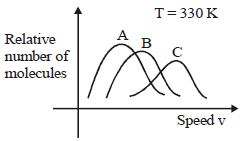
Maxwell distribution function is shown in figure for different gases, which of the following is correct matching?
A copper ring has a diameter of exactly $25 \,\,mm$ at its temperature of $0^o C$. An aluminium sphere has a diameter of exactly $25.05\,\, mm$ at its temperature of $100^o C$. The sphere is placed on top of the ring and two are allowed to come to thermal equilibrium, no heat being lost to the surrounding. The sphere just passes through the ring at the equilibrium temperature. The ratio of the mass of the sphere & ring is : (given : $\alpha_{Cu} = 17 × 10^{-6} /^o C, \alpha = 2.3 × 10^{-5} /^o C,$ specific heat of $Cu = 0.0923 Cal/g^o C$ and specific heat of $Al = 0.215 cal/g^o C$)
What can you say about the motion of an object if its speed-time graph is a straight line parallel to the time axis?
The contact force exerted by a body $A$ on another body $B$ is equal to the normal force between the bodies. We conclude that:
  1. The surfaces must be frictionless.
  2. The force of friction between the bodies is zero.
  3. The magnitude of normal force equals that of friction.
  4. The bodies may be rough but they don't slip on each other.