MCQ
A cyclist taking turn bends inwards while a car passenger taking same turn is thrown outwards. The reason is
  • A
    Car is heavier than cycle
  • B
    Car has four wheels while cycle has only two
  • C
    Difference in the speed of the two
  • Cyclist has to counteract the centrifugal force while in the case of car only the passenger is thrown by this force
Answer

Correct option: D.
Cyclist has to counteract the centrifugal force while in the case of car only the passenger is thrown by this force
d
(d) The Correct Option is $(d)$ Cyclist has to counteract the centrifugal force while in the case of car only the passenger is thrown by this force

Need a full question paper?

Generate a complete, print-ready paper with questions like this in minutes — across 16+ boards, with answer keys.

Start Generating Free

Similar questions

Given below are two statements :

Statement-I: When a capillary tube is dipped into a liquid, the liquid neither rises nor falls in the capillary. The contact angle may be $0^{\circ}$.

Statement-II: The contact angle between a solid and a liquid is a property of the material of the solid and liquid as well :

In the light of above statement, choose the correct answer from the options given below.

A planet is moving in an elliptical orbit around the sun. If $T, V, E$ and $L$ stand respectively for its kinetic energy, gravitational potential energy, total energy and magnitude of angular momentum about the centre of force, which of the following is correct ?
A liquid will not wet the surface of a solid, if the angle of contact is:
A tuning fork of frequency $340\, Hz$ is sounded above an organ pipe of length $120\, cm$. Water is now slowly poured in it. The minimum height of water column required for resonance is .... $cm$ (speed of sound in air $= 340 \,m/s$)
An object is placed in a medium of refractive index $3$. An electromagnetic wave of intensity $6 \times 10^8 \mathrm{~W} / \mathrm{m}^2$ falls normally on the object and it is absorbed completely. The radiation pressure on the object would be (speed of light in free space $=3 \times 10^8 \mathrm{~m} / \mathrm{s}$ ):
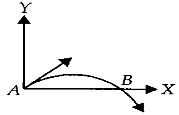
The velocity of projectile at the intial point $A$ is $\left( {2\hat i + 3\hat j} \right)$ $m/s $ . It's velocity (in $m/s$) at point $B$ is
One mole of ideal gas required 207J heat to rise the temperature by 10°K when heated at constant pressure. If the same gas is heated at constant volume to raise the temperature by the same 10°K the heat required is (R = 8/ 3J/ mole°K)
A train is moving at a constant speed $V$. When its driver observes another train in front of him on the same track and moving in the same direction with constant speed $u$. If the distance between the trains be $x$, then what should be the minimum retardation of the train so as to avoid collision?
A ball is bouncing elastically with a speed 1m/s between walls of a railway compartment of size 10m in a direction perpendicular to walls. The train is moving at a constant velocity of 10m/s parallel to the direction of motion of the ball. As seen from the ground,
  1. The direction of motion of the ball changes every 10 seconds.
  2. Speed of ball changes every 10 seconds.
  3. Average speed of ball over any 20 second interval is fixed.
  4. The acceleration of ball is the same as from the train.