Question
A cylindrical capacitor is constructed using two coaxial cylinders of the same length 10cm and of radii 2mm and 4mm:
  1. Calculate the capacitance.
  2. Another capacitor of the same length is constructed with cylinders of radii 4mm and 8mm. Calculate the capacitance.
Answer

  1. $\text{C}=\frac{2\epsilon_0\text{L}}{\text{ln}\big(\frac{\text{R}_2}{\text{R}_1}\big)}=\frac{\text{e}\times3.14\times8.85\times10^{-2}\times10^{-1}}{\text{ln}2}$ $[\text{ln 2}=0.6932]$
$=80.17\times10^{-13}$
$\Rightarrow8\text{PF}$
  1. Same as $\frac{\text{R}_2}{\text{R}_1}$ will be same.

Need a full question paper?

Generate a complete, print-ready paper with questions like this in minutes — across 16+ boards, with answer keys.

Start Generating Free

Similar questions

Can you ever have a situation in which a light ray goes undeviated through a prism?
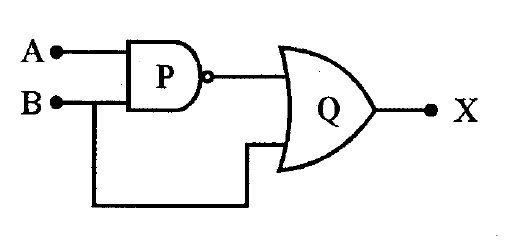
Identify the logic gates marked 'P' and 'Q' in the given circuit. Write the truth table for the combination.
Why is there no dispersion in the light refracted through a rectangular glass slab?
Three particles of mass m each are placed at the three corners of an equilateral triangle of side a. Find the work which should be done on this system to increase the sides of the triangle to 2a.
Using Rutherford model of the atom, derive the expression for the total energy of the electron in hydrogen atom. What is the significance of total negative energy possessed by the electron?
Two towers on top of two hills are $40 \ km$ apart. The line joining them passes $50 m$ above a hill halfway between the towers. What is the longest wavelength of radio waves, which can be sent between the towers without appreciable diffraction effects?
Two voltameters, one having a solution of silver salt and the other of a trivalent-metal salt, are connected in series and a current of 2A is maintained for 1.50 hours. It is found that 1.00g of the trivalent-metal is deposited.
  1. What is the atomic weight of the trivalent metal?
  2. How much silver is deposited during this period? Atomic weight of silver is 107.9 g/mole.
A plate of thickness t made of a material of refractive index $\mu$ is placed in front of one of the slits in a double slit experiment.
  1. Find the change in the optical path due to introduction of the plate.
  2. What should be the minimum thickness t which will make the intensity at the centre of the fringe pattern zero? Wavelength of the light used is $\lambda$. Neglect any absorption of light in the plate.
Explain the principle of working of a meter bridge. Draw the circuit diagram for determination of an unknown resistance using it.
Lattice structure of $C , Si$ and Ge is similar. Still, why is C an insulator while Si and Ge are intrinsic semiconductors?