Question
A cylindrical capacitor is constructed using two coaxial cylinders of the same length 10cm and of radii 2mm and 4mm:
  1. Calculate the capacitance.
  2. Another capacitor of the same length is constructed with cylinders of radii 4mm and 8mm. Calculate the capacitance.
Answer

  1. $\text{C}=\frac{2\epsilon_0\text{L}}{\text{ln}\big(\frac{\text{R}_2}{\text{R}_1}\big)}=\frac{\text{e}\times3.14\times8.85\times10^{-2}\times10^{-1}}{\text{ln}2}$ $[\text{ln 2}=0.6932]$
$=80.17\times10^{-13}$
$\Rightarrow8\text{PF}$
  1. Same as $\frac{\text{R}_2}{\text{R}_1}$ will be same.

Need a full question paper?

Generate a complete, print-ready paper with questions like this in minutes — across 16+ boards, with answer keys.

Start Generating Free

Similar questions

Estimate the distance for which ray optics is good approximation for an aperture of $4 \ mm$ and wavelength $400 \ nm.$
Give the mass number and atomic number of elements on the right hand side of the decay process.
$^{220}_{86}\text{Ru}\ \ \rightarrow\ \ \text{Po}\ \ +\ \ \text{He}$
Find the maximum angle of refraction when a light ray is refracted from glass $(\mu=1.50)$ to air.
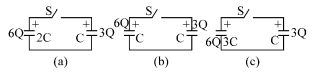
Three circuits, each consisting of a switch ' S ' and two capacitors, are initially charged as shown in the figure. In which circuit, when the switch is closed, the charge on the given capacitor will (i) increase, (ii) decrease and (iii) remain unchanged? Give reason.
Image
Draw a plot of the binding energy per nucleon as a function of mass number for a large number of nuclei, 2⩽ A⩽240. How do you explain the constancy of binding energy per nucleon in the range 30 < A < 170 using the property that nuclear force is short - ranged?
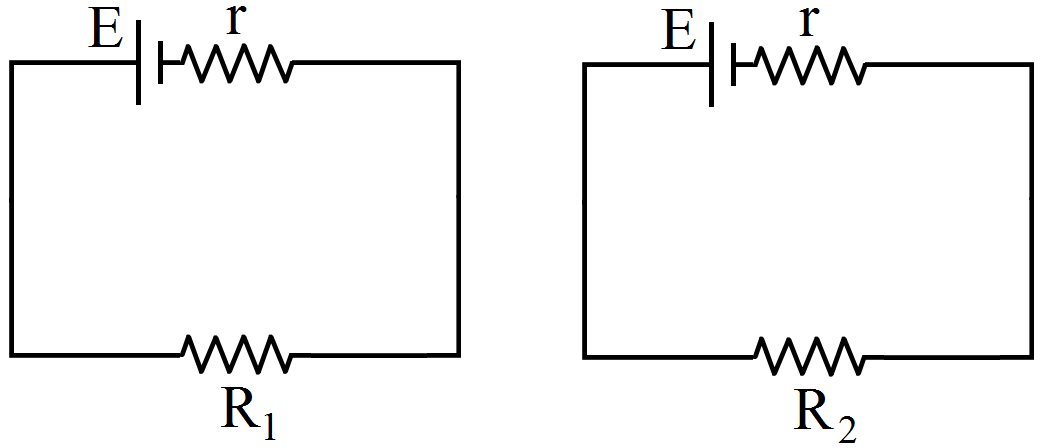
Two unequal resistances $R_1$ and $R_2$ are connected across two identical batteries of emf $\varepsilon$ and internal resistance $r.$ Can the thermal energies developed in $R_1$ and $R_{2}$ be equal in a given time. If yes, what will be the condition?
What will be the path of a charged particle moving in a region of crossed (or transverse) uniform electrostatic and magnetic fields with initial velocity zero?
Explain by graph how the electric field by thin spherical shell depends on the distance, of point from centre.
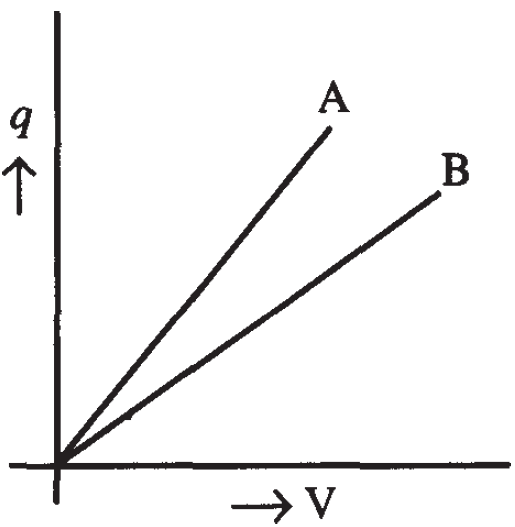
The given graph shows the variation of charge $q$ versus potential difference $V$ for two capacitors $C_1$ and $C_2.$ The two capacitors have same plate separation, but the plate area of $C_2$ is double than that of $C_1.$ Which of the lines in the graph correspond to $C_1$ and $C_2$ and why?
Give a physical explanation of the fact that the potential energy of a positive charge coupled is positive.