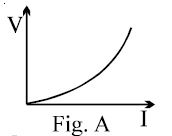
A cylindrical conductor has uniform cross-section. Resistivity of its material increase linearly from left end to right end. If a constant current is flowing through it and at a section distance $x$ from left end, magnitude of electric field intensity is $E$, which of the following graphs is correct
Easy
Download our app for free and get started
Let resistivity at a distance '$x$' from left end be $\rho = ({\rho _0} + ax).$ Then electric field intensity at a distance '$x$' from left end will be equal to $E = \frac{{i\rho }}{A} = \frac{{i({\rho _0} + ax)}}{A}$ where $i$ is the current flowing through the conductor. It means $E \propto \rho $ or $E$ varies linearly with distance '$x$'. But at $x = 0$, $E$ has non-zero value. Hence $(b) $ is correct.

Download our appand get started for free
Experience the future of education. Simply download our apps or reach out to us for more information. Let's shape the future of learning together!No signup needed.*
Similar Questions
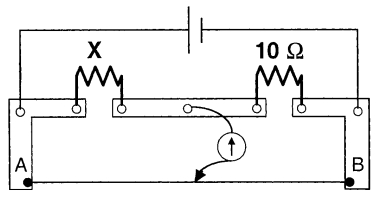
- 1A meter bridge is set-up as shown, to determine an unknown resistance ' $X$ ' using a standard $10$ ohm resistor. The galvanometer shows null point when tapping-key is at $52 \ cm$ mark. The end-corrections are $1 \ cm$ and $2 \ cm$ respectively for the ends $A$ and $B$. The determined value of ' $X$ ' isView Solution
- 2View SolutionA heater coil is cut into two equal parts and only one part is now used in the heater. The heat generated will now be
- 3A uniform wire of resistance $R$ is uniformly compressed along its length, until its radius becomes $n$ times the original radius. Now resistance of the wire becomesView Solution
- 4View SolutionThe drift velocity does not depend upon
- 5To get maximum current through a resistance of $2.5\,\Omega $, one can use $m$ rows of cells, each row having $n$ cells. The internal resistance of each cell is $0.5\,\Omega $. What are the values of $n$ and $m$ if the total number of cells is $45$ ?View Solution
- 6Three light bulbs of $40\, W$, $60\, W$ and $100\, W$ are connected in series with $220\, V$ source. Which one of the bulbs will glow brightest ............ $W$View Solution
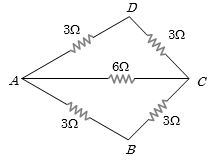
- 7The effective resistance between the points $A$ and $B$ in the figure is ............. $\Omega$View Solution
- 8A wire of radius $r$ has resistance $R$. If it is stretched to a radius of $\frac{{3r}}{4}$, its resistance becomesView Solution
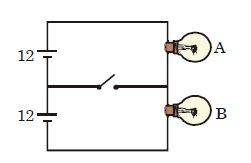
- 9Two light bulbs in the circuit have rating $A\,[24\ V, 48\,W]$ and $B\,[24\ V, 36\,W]$ as shown.View Solution
- 10The variation of current $(I)$ and voltage $(V)$ is as shown in figure $A$. The variation of power $P$ with current $I$ is best shown by which of the following graphView Solution