Question
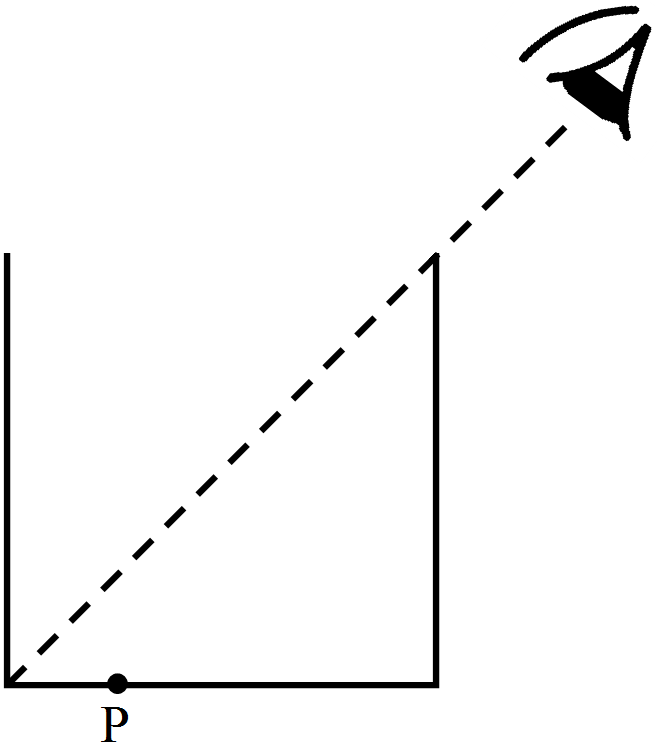
A cylindrical vessel, whose diameter and height both are equal to 30cm, is placed on a horizontal surface and a small particle P is placed in it at a distance of 5.0cm from the centre. An eye is placed at a position such that the edge of the bottom is just visible. The particle P is in the plane of drawing. Up to what minimum height should water be poured in the vessel to make the particle P visible?
Answer

For the given cylindrical vessel, dimetre = 30cm

⇒ r = 15cm and h = 30cm

Now, $\frac{\sin\text{i}}{\sin\text{r}}=\frac{3}{4}\Big[\mu_{\text{w}}=1.33=\frac{4}{3}\Big]$
$\Rightarrow\sin\text{i}=\frac{3}{4\sqrt{2}} \ \big[\because \text{r}=45^{\circ}\big]$

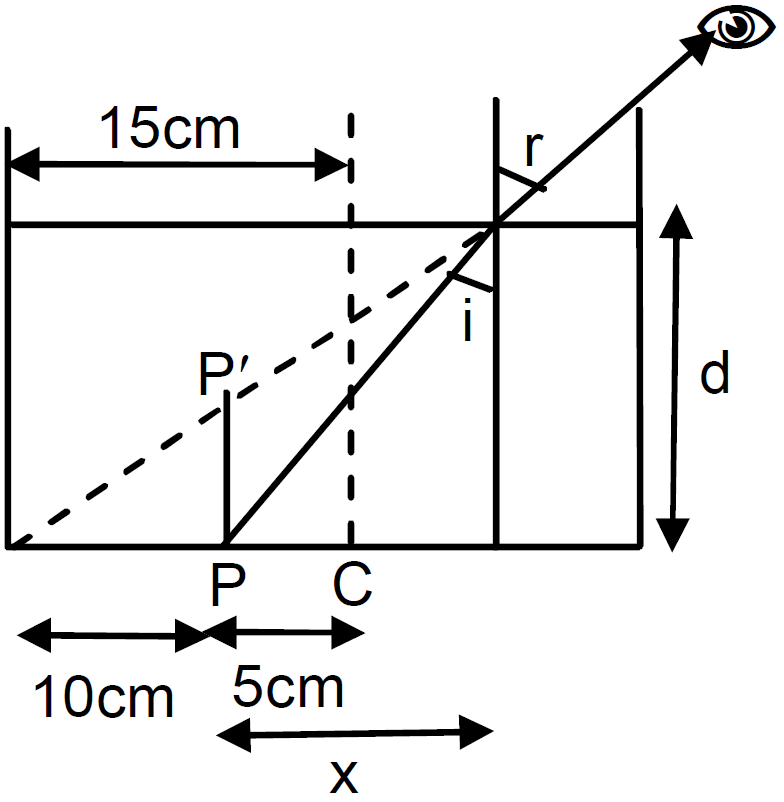
The point P will be visible when the refracted ray makes angle 45° at point of refraction.

Let x = distance of point P from X.

Now, $\tan45^{\circ}=\frac{\text{x}+10}{\text{d}}$

$\Rightarrow\text{d}=\text{x}+10 \ ...(1)$

Again, $\tan\text{i}=\frac{\text{x}}{\text{d}}$

$\Rightarrow\frac{3}{\sqrt{23}}=\frac{\text{d}-10}{\text{d}} \ \Big[\text{Since,} \ \sin\text{i}=\frac{3}{4\sqrt{2}}\Rightarrow\tan\text{i}=\frac{3}{4\sqrt{2}}\Big]$

$\Rightarrow\frac{3}{\sqrt{23}}-1=-\frac{10}{\text{d}}\Rightarrow\text{d}=\frac{\sqrt{23}\times10}{\sqrt{23}-3}=26.7\text{cm}$

Need a full question paper?

Generate a complete, print-ready paper with questions like this in minutes — across 16+ boards, with answer keys.

Start Generating Free

Similar questions

Explain the concept of energy bands with a figure.
Two blocks of masses 400g and 200g are connected through a light string going over a pulley which is free to rotate about its axis. The pulley has a moment of inertia 1.6 x 10⁻⁴kg-m2 and a radius 2.0cm. Find:
  1. The kinetic energy of the system as the 400g block falls through 50cm.
  2. The speed of the blocks at this instant.
  1. Draw the ray diagram showing refraction of light through a glass prism and hence obtain the relation between the refractive index $\mu$ of the prism, angle of prism and angle of minimum deviation.
  2. Determine the value of the angle of incidence for a ray of light travelling from a medium of refractive index $\mu_1=\sqrt{2}$ into the medium of refractive index $\mu_2=1$, so that it just grazes along the surface of separation.
A body cools down from 50°C to 45°C in 5 minutes and to 40°C in another 8 minutes. Find the temperature of the surrounding.
Find the mass, the kinetic energy and the momentum of an electron moving at O.8c.
A composite slab is prepared by pasting two plates of thicknesses L1 and L2 and thermal conductivities K1 and K2. The slabs have equal cross-sectional area. Find the equivalent conductivity of the composite slab.
What is capacitance of a conductor? What is its unit? Find the formula for capacitance of an isolated spherical conductor. Draw a graph between capacitance and radius. If a spherical conductor is placed in dielectric constant $\in_r$, then what will be the effect on the value of capacitance?###If the area of each conducting plate of a parallel plate capacitor is A and the separation between them is $d$, then express the formula for its capacitance.
A glass vessel measures exactly 10cm × 10cm × 10cm at 0°C. It is filled completely with mercury at this temperature. When the temperature is raised to 10°C, 1.6cm3 of mercury overflows. Calculate the coefficient of volume expansion of mercury. Coefficient of linear expansion of glass = 6.5 × 10⁻⁶ °C.
In a series LCR circuit with an AC source, $\text{R}=300\Omega,\text{C}=20\mu\text{F},\text{L}=1.0\text{ henry},\in_0=50\text{V}$ and $\nu=\frac{50}{\pi}\text{Hz}.$ Find:
  1. The rms current in the circuit.
  2. The rms potential difference across the capacitor, the resistor and the inductor. Note that the sum of the rms potential differences across the three elements is greater than the rms voltage of the source.