Question
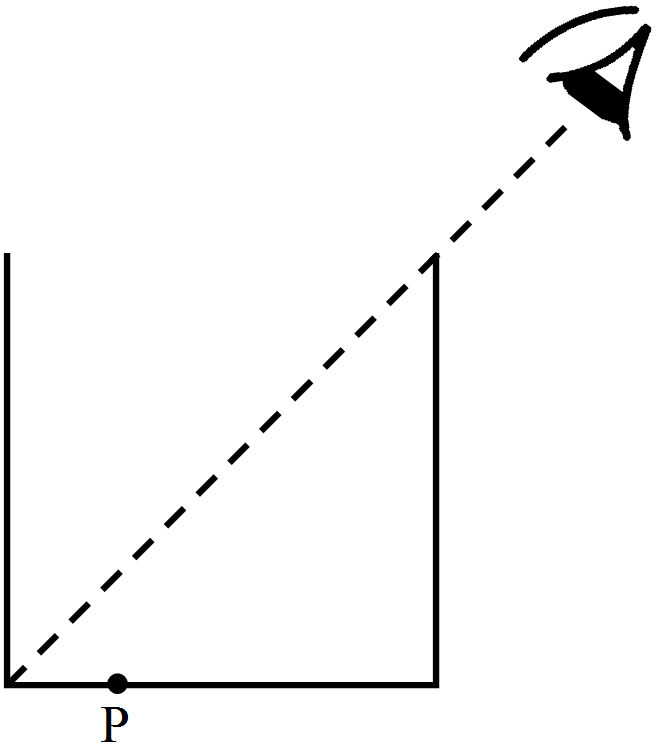
A cylindrical vessel, whose diameter and height both are equal to 30cm, is placed on a horizontal surface and a small particle P is placed in it at a distance of 5.0cm from the centre. An eye is placed at a position such that the edge of the bottom is just visible. The particle P is in the plane of drawing. Up to what minimum height should water be poured in the vessel to make the particle P visible?
Answer

For the given cylindrical vessel, dimetre = 30cm

⇒ r = 15cm and h = 30cm

Now, $\frac{\sin\text{i}}{\sin\text{r}}=\frac{3}{4}\Big[\mu_{\text{w}}=1.33=\frac{4}{3}\Big]$

$\Rightarrow\sin\text{i}=\frac{3}{4\sqrt{2}} \ \big[\because \text{r}=45^{\circ}\big]$

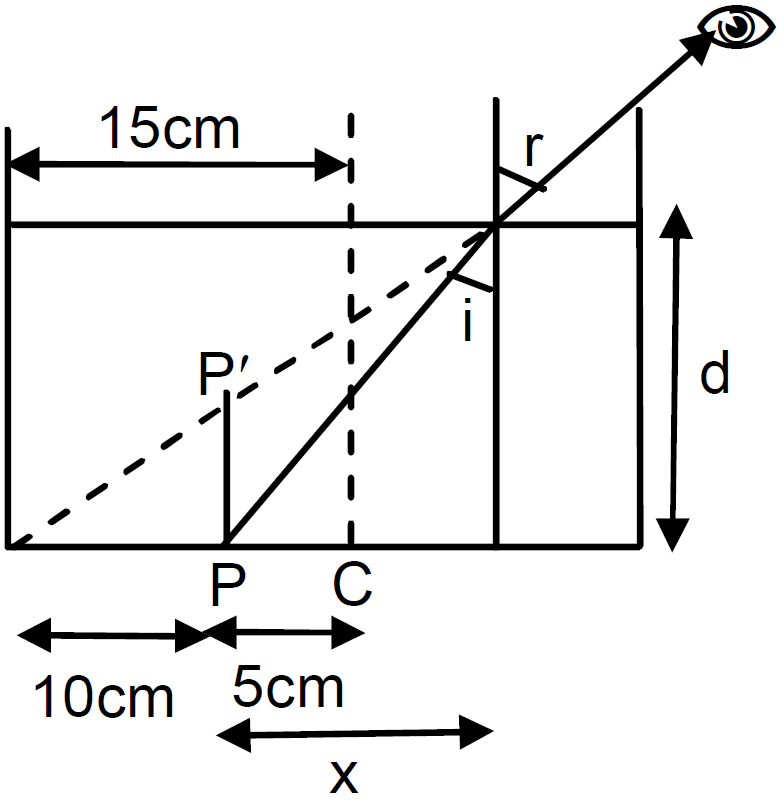
The point P will be visible when the refracted ray makes angle 45° at point of refraction.

Let x = distance of point P from X.

Now, $\tan45^{\circ}=\frac{\text{x}+10}{\text{d}}$

$\Rightarrow\text{d}=\text{x}+10 \ ...(1)$

Again, $\tan\text{i}=\frac{\text{x}}{\text{d}}$

$\Rightarrow\frac{3}{\sqrt{23}}=\frac{\text{d}-10}{\text{d}} \ \Big[\text{Since,} \ \sin\text{i}=\frac{3}{4\sqrt{2}}\Rightarrow\tan\text{i}=\frac{3}{4\sqrt{2}}\Big]$

$\Rightarrow\frac{3}{\sqrt{23}}-1=-\frac{10}{\text{d}}\Rightarrow\text{d}=\frac{\sqrt{23}\times10}{\sqrt{23}-3}=26.7\text{cm}$

Need a full question paper?

Generate a complete, print-ready paper with questions like this in minutes — across 16+ boards, with answer keys.

Start Generating Free

Similar questions

A disc of radius R is rotating with an angular speed $\omega_\text{o}$ about a horizontal axis. It is placed on a horizontal table. The coefficient of kinetic friction is $\mu_\text{k}{:}$
  1. What was the velocity of its centre of mass before being brought in contact with the table?
  2. What happens to the linear velocity of a point on its rim when placed in contact with the table?
  3. What happens to the linear speed of the centre of mass when disc is placed in contact with the table?
  4. Which force is responsible for the effects in (b) and (c).
  5. What condition should be satisfied for rolling to begin?
  6. Calculate the time taken for the rolling to begin.
A solenoid of length 20cm, area of cross-section 4.0cm2 and having 4000 turns is placed inside another solenoid of 2000 turns having a cross-sectional area 8.0cm2 and length 10cm. Find the mutual inductance between the solenoids.
The bob A of a pendulum released from horizontal to the vertical hits another bob B of the same mass at rest on a table as shown in.

If the length of the pendulum is 1m, calculate.

  1. The height to which bob A will rise after collision.
  2. The speed with which bob B starts moving. Neglect the size of the bobs and assume the collision to be elastic.
The transverse displacement of a string (clamped at its both ends) is given by
$\text{y}(\text{x, t})=0.06\sin\Big(\frac{2\pi}{3}\text{x}\Big)\cos(120\pi\text{ t})$
where x and y are in m and t in s. The length of the string is 1.5m and its mass is 3.0 × 10–2kg.
Answer the following:
Determine the tension in the string.
A sphere of $0.047 kg$ aluminium is placed for sufficient time in a vessel containing boiling water, so that the sphere is at $100^{\circ} C$. It is then immediately transfered to $0.14 kg$ copper calorimeter containing $0.25 kg$ water at $20^{\circ} C$. The temperature of water rises and attains a steady state at $23^{\circ} C$. Calculate the specific heat capacity of aluminium.
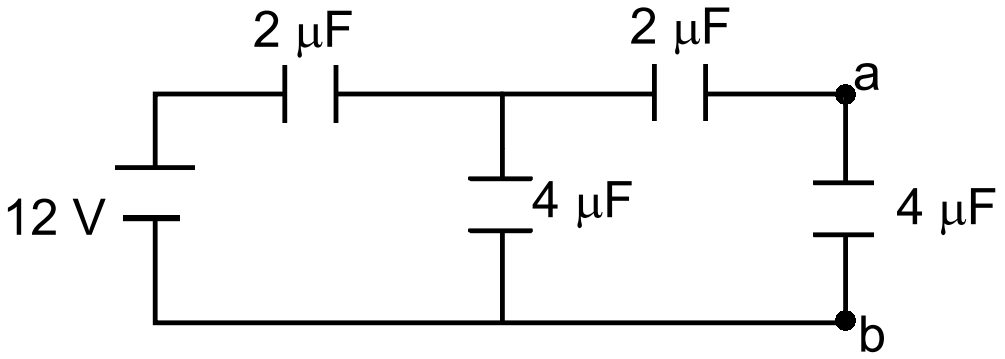
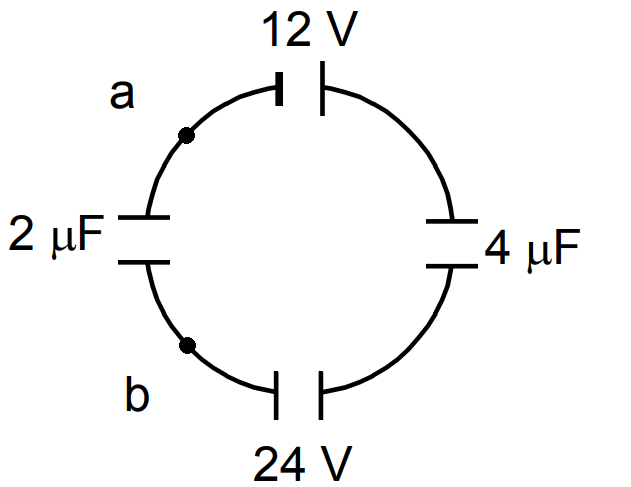
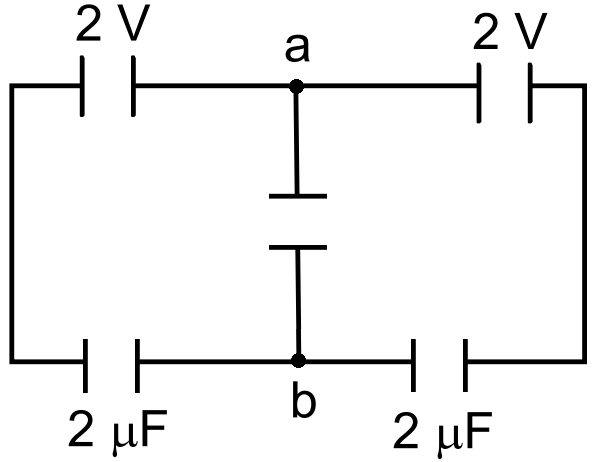
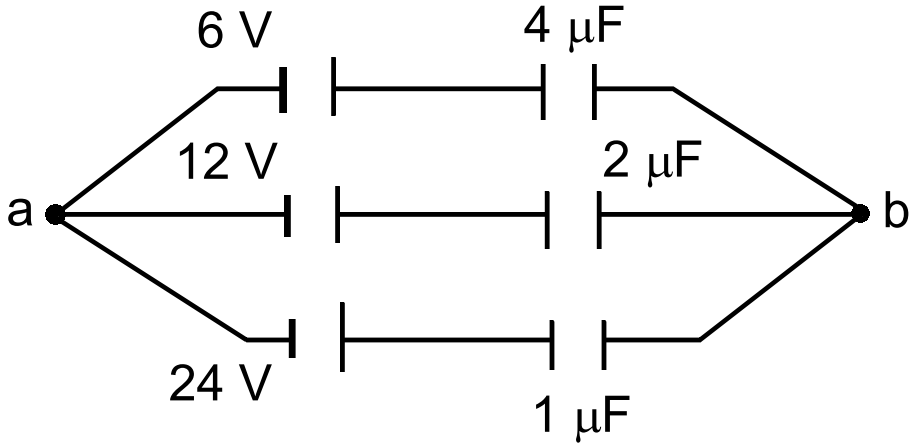
Find the potential difference Va - Vb between the points a and b shown in each part of the figure.


In the given progressive wave $​​​​\text{y}=5\sin(100\pi\text{t+0.4x})$ where y and x are in m, t is in s. What is the:
Particle velocity amplitude.
Two sitar strings A and B playing the note ‘Ga’ are slightly out of tune and produce beats of frequency 6Hz. The tension in the string A is slightly reduced and the beat frequency is found to reduce to 3Hz. If the original frequency of A is 324Hz, what is the frequency of B?
Consider the situation shown in figure. The system is released from rest and the block of mass 1.0kg is found to have a speed 0.3m/s after it has descended through a distance of 1m. Find the coefficient of kinetic friction between the block and the table.

Consider that an ideal gas (n moles) is expanding in a process given by P = f( V ), which passes through a point (V0, P0 ). Show that the gas is absorbing heat at (P0, V0 ) if the slope of the curve P = f(V ) is larger than the slope of the adiabat passing through (P0, V0 ).