Question
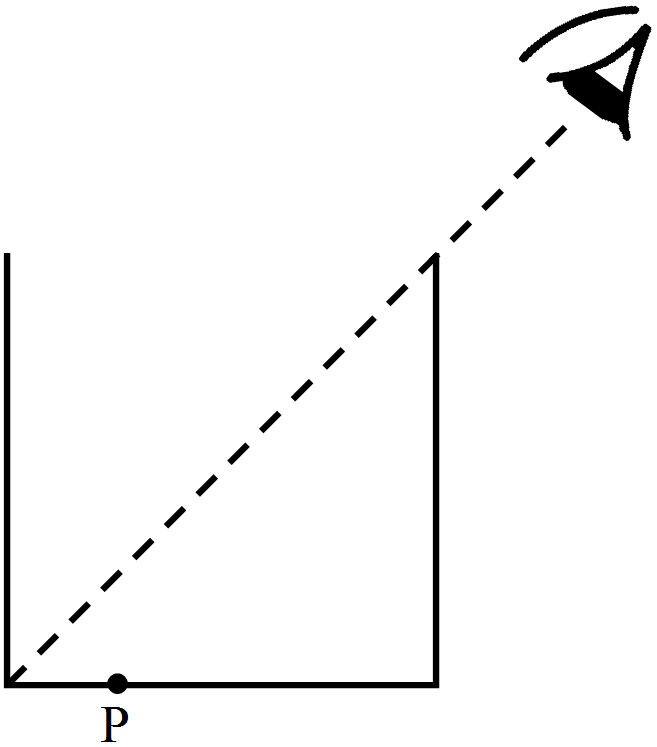
A cylindrical vessel, whose diameter and height both are equal to 30cm, is placed on a horizontal surface and a small particle P is placed in it at a distance of 5.0cm from the centre. An eye is placed at a position such that the edge of the bottom is just visible. The particle P is in the plane of drawing. Up to what minimum height should water be poured in the vessel to make the particle P visible?
Answer


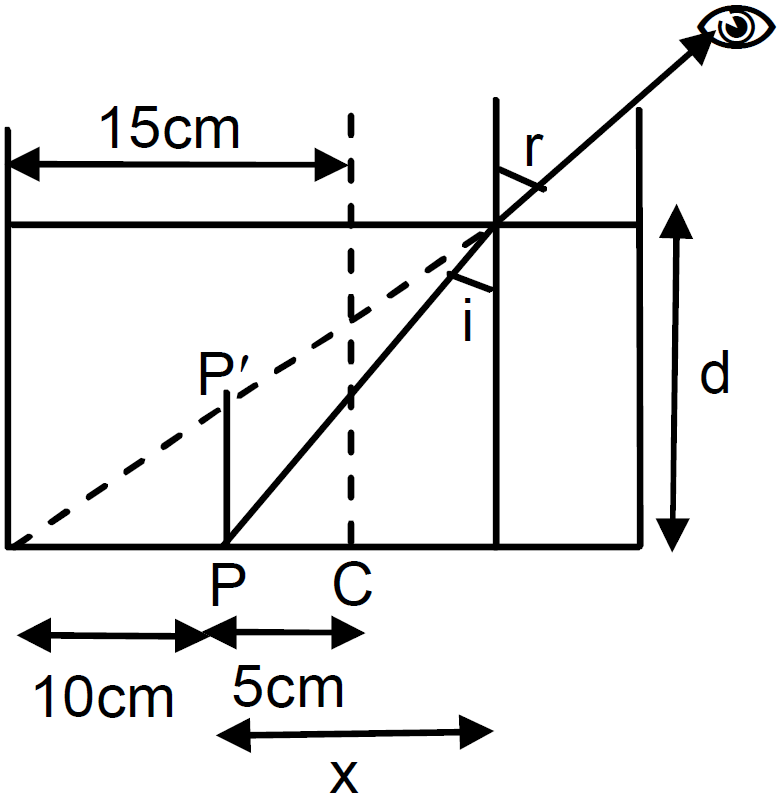
For the given cylindrical vessel, dimetre = 30cm
⇒ r = 15cm and h = 30cm
Now, $\frac{\sin\text{i}}{\sin\text{r}}=\frac{3}{4}\Big[\mu_{\text{w}}=1.33=\frac{4}{3}\Big]$
$\Rightarrow\sin\text{i}=\frac{3}{4\sqrt{2}} \ \big[\because \text{r}=45^{\circ}\big]$
The point P will be visible when the refracted ray makes angle 45° at point of refraction.
Let x = distance of point P from X.
Now, $\tan45^{\circ}=\frac{\text{x}+10}{\text{d}}$
$\Rightarrow\text{d}=\text{x}+10 \ ...(1)$
Again, $\tan\text{i}=\frac{\text{x}}{\text{d}}$
$\Rightarrow\frac{3}{\sqrt{23}}=\frac{\text{d}-10}{\text{d}} \ \Big[\text{Since,} \ \sin\text{i}=\frac{3}{4\sqrt{2}}\Rightarrow\tan\text{i}=\frac{3}{4\sqrt{2}}\Big]$
$\Rightarrow\frac{3}{\sqrt{23}}-1=-\frac{10}{\text{d}}\Rightarrow\text{d}=\frac{\sqrt{23}\times10}{\sqrt{23}-3}=26.7\text{cm}$

Need a full question paper?

Generate a complete, print-ready paper with questions like this in minutes — across 16+ boards, with answer keys.

Start Generating Free

Similar questions

The earth revolves round the sun due to gravitational attraction. Suppose that the sun and the earth are point particles with their existing masses and that Bohr's quantization rule for angular momentum is valid in the case of gravitation. (a) Calculate the minimum radius the earth can have for its orbit. (b) What is the value of the principal quantum number n for the present radius? Mass of the earth = 6.0 × 10⁻²⁴kg. Mass of the sun = 2.0 × 1030kg, earth-sun distance = 1.5 × 10¹¹m.
A car is speeding up on a horizontal road with an acceleration a. Consider the following situations in the car.
  1. A ball is suspended from the ceiling through a string and is maintaining a constant angle with the vertical. Find this angle.
  2. A block is kept on a smooth incline and does not slip on the incline. Find the angle of the incline with the horizontal.
In Fig. the energy stored in $C _4$ is 27 J . Calculate the total energy stored in the system.
Image
A uniform field of 2.0NC-1 exists in space in x-direction.
  1. Taking the potential at the origin to be zero, write an expression for the potential at a general point (x, y, z).
  2. At which points, the potential is 25V?
  3. If the potential at the origin is taken to be 100V, what will be the expression for the potential at a general point?
  4. What will be the potential at the origin if the potential at infinity is taken to be zero? Is it practical to choose the potential at infinity to be zero?
The energy from the sun reaches just outside the earth's atmosphere at a rate of 1400W/m2. The distance between the sun and the earth is 1.5 × 10¹¹m.
  1. Calculate the rate at which the sun is losing its mass.
  2. How long will the sun last assuming a constant decay at this rate? The present mass of the sun is 2 × 1080kg.


  1. Name the type of a diode whose characteristics are shown in Fig. (A) and Fig. (B).
  2. What does the point P in Fig. (A) represent?
  3. What does the points P and Q in Fig. (B) represent?
Write characteristics of different components of electromagnetic waves and describe them.
(I) Explain briefly, with the help of a labelled diagram, the basic principle of the working of an a.c. generator. In an a.c. generator, coil of N turns and area A is rotated at an angular velocity ω in a uniform magnetic field B. Derive an expression for the instantaneous value of the emf induced in coil. What is the source of energy generation in this device?
A horizontal cesium plate ($\phi$ = l.9 eV) is moved vertically downward at a constant speed u in a room full of radiation of wavelength 250 run and above. What should be the minimum value of u so that the vertically upward component of velocity is nonpositive for each photoelectron?
A bullet of mass 20g moving horizontally at a speed of 300m/s is fired into a wooden block of mass 500g suspended by a long string. The bullet crosses the block and emerges on the other side. If the centre of mass of the block rises through a height of 20.0cm, find the speed of the bullet as it emerges from the block.