Question
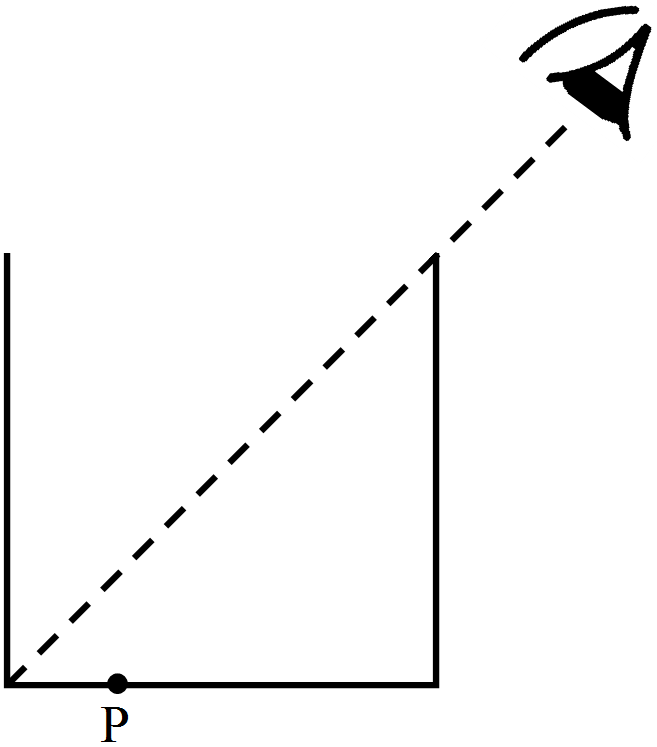
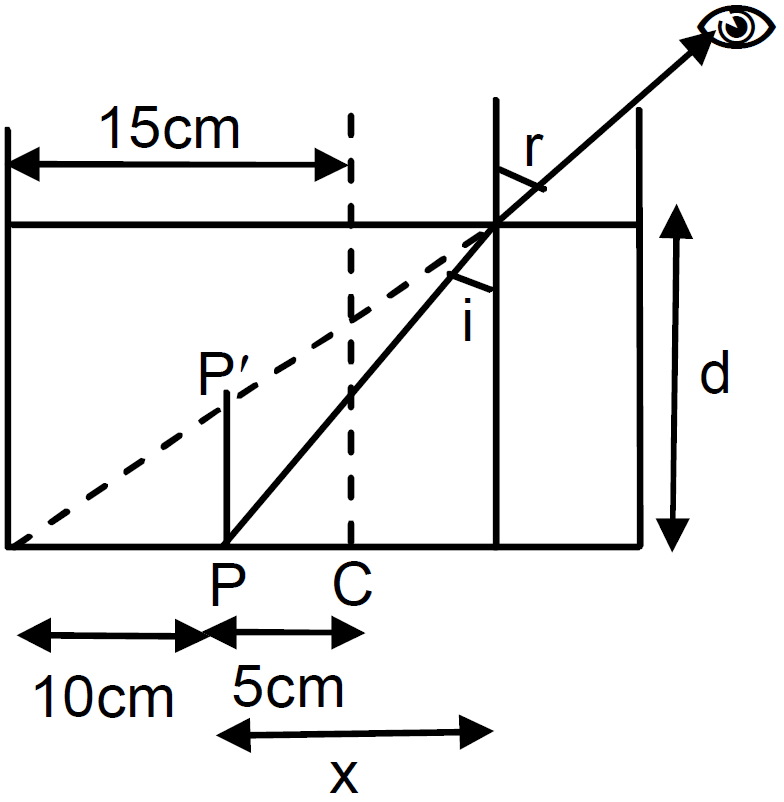
A cylindrical vessel, whose diameter and height both are equal to 30cm, is placed on a horizontal surface and a small particle P is placed in it at a distance of 5.0cm from the centre. An eye is placed at a position such that the edge of the bottom is just visible. The particle P is in the plane of drawing. Up to what minimum height should water be poured in the vessel to make the particle P visible?
Answer


For the given cylindrical vessel, dimetre = 30cm
⇒ r = 15cm and h = 30cm
Now, $\frac{\sin\text{i}}{\sin\text{r}}=\frac{3}{4}\Big[\mu_{\text{w}}=1.33=\frac{4}{3}\Big]$
$\Rightarrow\sin\text{i}=\frac{3}{4\sqrt{2}} \ \big[\because \text{r}=45^{\circ}\big]$
The point P will be visible when the refracted ray makes angle 45° at point of refraction.
Let x = distance of point P from X.
Now, $\tan45^{\circ}=\frac{\text{x}+10}{\text{d}}$
$\Rightarrow\text{d}=\text{x}+10 \ ...(1)$
Again, $\tan\text{i}=\frac{\text{x}}{\text{d}}$
$\Rightarrow\frac{3}{\sqrt{23}}=\frac{\text{d}-10}{\text{d}} \ \Big[\text{Since,} \ \sin\text{i}=\frac{3}{4\sqrt{2}}\Rightarrow\tan\text{i}=\frac{3}{4\sqrt{2}}\Big]$
$\Rightarrow\frac{3}{\sqrt{23}}-1=-\frac{10}{\text{d}}\Rightarrow\text{d}=\frac{\sqrt{23}\times10}{\sqrt{23}-3}=26.7\text{cm}$

Need a full question paper?

Generate a complete, print-ready paper with questions like this in minutes — across 16+ boards, with answer keys.

Start Generating Free

Similar questions

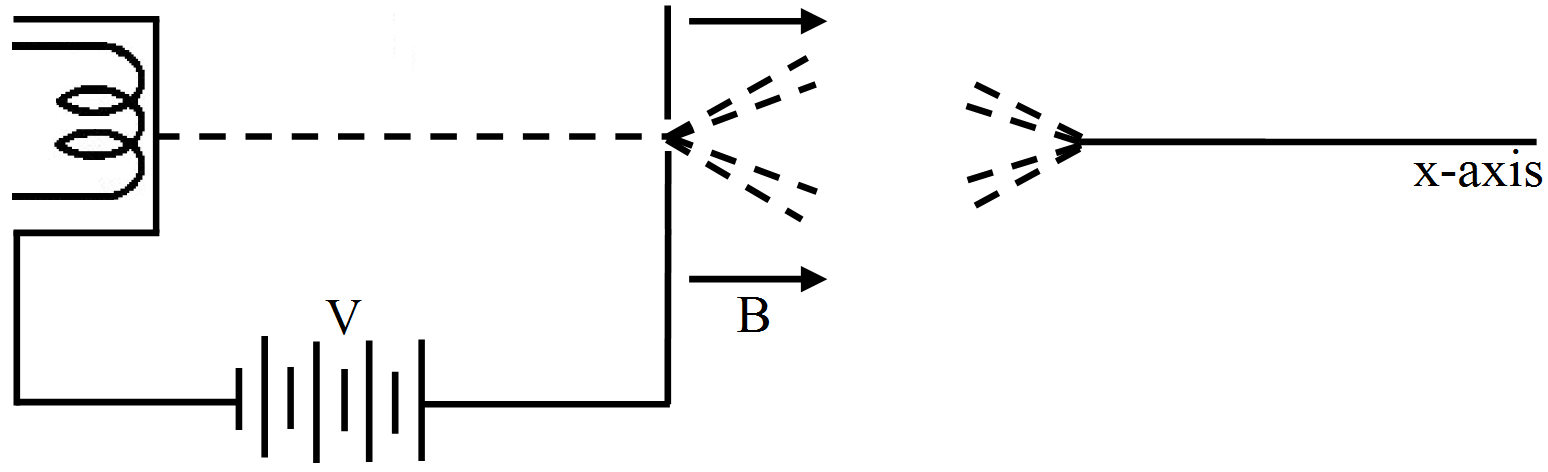
Electrons emitted with negligible speed from an electron gun are accelerated through a potential difference V along the x-axis. These electrons emerge from a narrow hole into a uniform magnetic field B directed along this axis. However, some of the electrons emerging from the hole make slightly divergent angles, as shown in the figure. Show that these paraxial electrons are refocussed on the x-axis at a distance $\sqrt{\frac{8\pi^2\text{mV}}{\text{eB}^2}}.$
The $\text{K}_\alpha$ X-rays of aluminium (Z = 13) and zinc (Z = 30) have wavelengths 887pm and 146pm respectively. Use Moseley's law $\sqrt{\text{v}}=\text{a}(\text{z-b})$ to find the wavelengths of the $\text{K}_\alpha$ X-ray of iron (Z = 26).
The bob of a stationary pendulum is given a sharp hit to impart it a horizontal speed of $\sqrt{3\text{gl}}.$ Find the angle rotated by the string before it becomes slack.
Three identical charges, each having a value $1.0 \times 10^{-8}C$, are placed at the corners of an equilateral triangle of side 20cm. Find the electric field and potential at the centre of the triangle.
Two objects A and B are thrown upward simultaneously with the same speed. The mass of A is greater than the mass of B. Suppose the air exerts a constant and equal force of resistance on the two bodies:
  1. The two bodies will reach the same height.
  2. A will go higher than B.
  3. B will go higher than A.
  4. Any of the above three may happen depending on the speed with which the objects are thrown.
A copper wire having resistance 0.01 ohm in each metre is used to wind a 400-turn solenoid of radius 1.0cm and length 20cm. Find the emf of a battery which when connected the solenoid will eauee a magnetic field of $1.0 \times 10^{-2}T$ near the centre of the solenoid.
A rod of length L has a total charge Q distributed uniformly along its length. It is bent in the shape of a semicircle. Find the magnitude of the electric field at the centre of curvature of the semicircle.
Two small spheres, each having a mass of 20g, are suspended from a common point by two insulating strings of length 40cm each. The spheres are identically charged and the separation between the balls at equilibrium is found to be 4cm. Find the charge on each sphere.
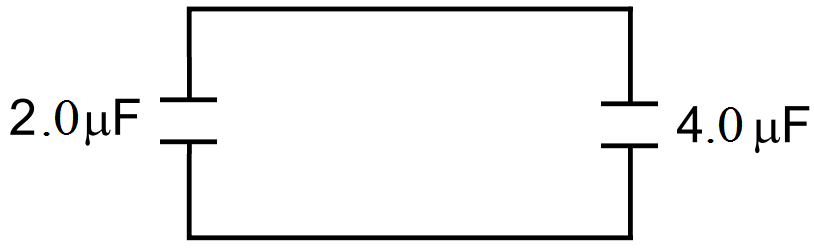
A capacitor of capacitance $2.0\mu\text{F}$ is charged to a potential difference of 12V. It is then connected to an uncharged capacitor of capacitance $4.0\mu\text{F}$ as shown in figure. Find:
  1. The charge on each of the two capacitors after the connection.
  2. The electrostatic energy stored in each of the two capacitors.
  3. The heat produced during the charge transfer from one capacitor to the other.
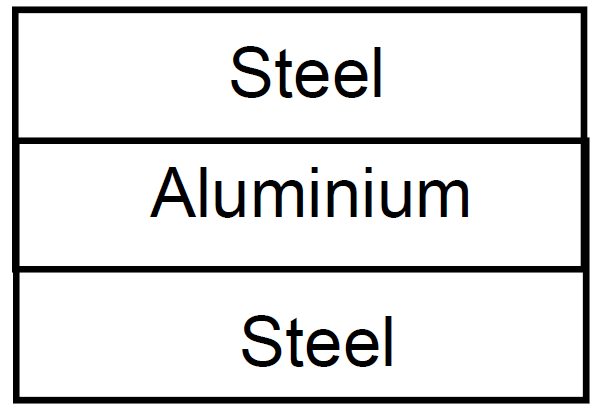
Two steel rods and an aluminium rod of equal length $l_0$ and equal cross section are joined rigidly at their ends as shown in the figure below. All the rods are in a state of zero tension at $0^\circ C$. Find the length of the system when the temperature is raised to $\theta$. Coefficient of linear expanaion of aluminium and steel are $\alpha_\text{a}$ and $\alpha_\text{s}$respectively. Young's modulus of aluminium is $Y_a$ and of steel is $Y_s.$​​​​​​​