Question
A circular loop carrying a current is replaced by ann equivalent magnetic dipole. A point on the axis of the loop is in:
- End-on position.
- Broadside-on position.
- Both.
- None.
Explanation:
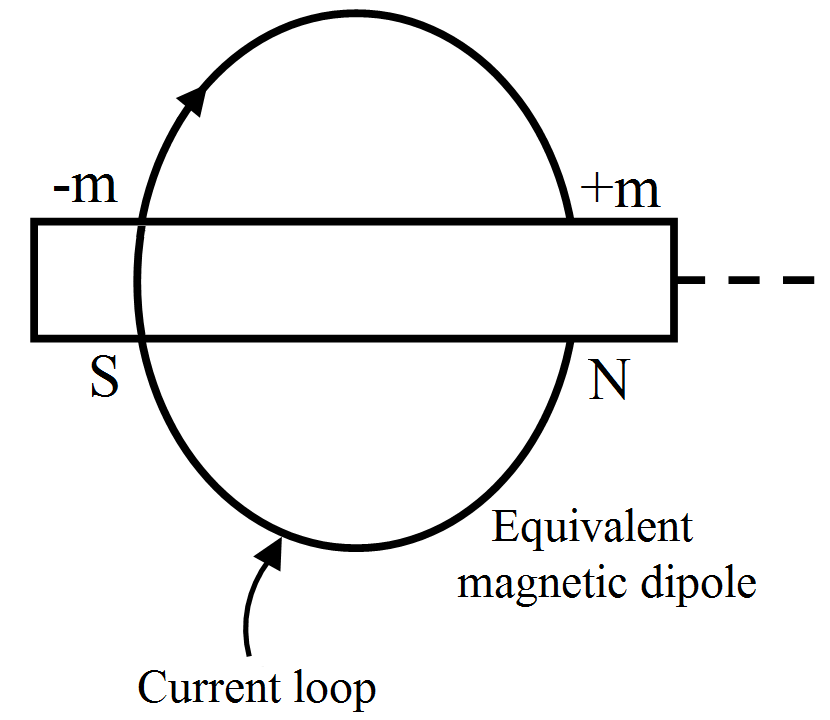
Points lying on the axis of a magnet are called end-on points. In our case, the point on the axis of the loop (on replacing the circular loop with an equivalent magnetic dipole) lies on the axis of the magnetic dipole or on the end-on position.
If P was the point on the axis of the loop, then it is clear from the figure that P lies on the end-on position of the equivalent magnetic dipole.
Generate a complete, print-ready paper with questions like this in minutes — across 16+ boards, with answer keys.
Assertion : The mass of b-particles when they are emitted is higher than the mass of electrons obtained by other means.
Reason : b-particle and electron, both are similar particles.
|
(a) If both assertion and reason are true and the reason is the correct explanation of the assertion. |
|
(b) If both assertion and reason are true but reason is not the correct explanation of the assertion. |
|
(c) If assertion is true but reason is false. |
|
(d) If the assertion and reason both are false. |
Photoelectric effect was successfully explained first by
|
(a) Planck |
(b) Hallwash |
(c) Hertz |
(d) Einstein |
10 wires (same length, same area, same material) are connected in parallel and each has 1 Ω resistance, then the equivalent resistance will be
|
(a) 10 Ω |
(b) 1 W |
(c) 0.1 W |
(d) 0.001 W |