Question
A circular loop of string rotates about its axis on a frictionless horizontal plane at a uniform rate so that the tangential speed of any particle of the string is v. If a small transverse disturbance is produced at. a point of the loop, with what speed (relative to the string) will this disturbance travel on the string?
Answer

m = mass per unit length of the string

R = Radius of the loop
$\omega=$ angular velocity, V = linear velocity of the string

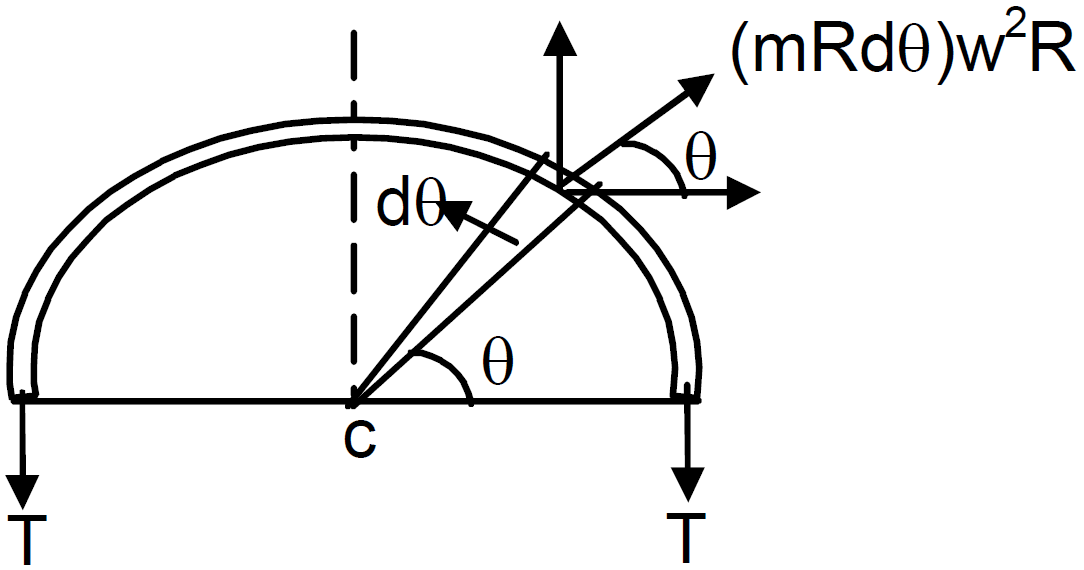
Consider one half of the string as shown in figure.

The half loop experiences cetrifugal force at every point, away from centre, which is balanced by tension 2T.

Consider an element of angular part $\text{d}\theta$ at angle $\theta.$ Consider another element symmetric to this centrifugal force experienced by the element $=(\text{mRd}\theta)\omega^2\text{R}.$

$\big($Length of element $=\text{Rd}\theta,\ \text{mass}=\text{mRd}\theta\big)$

Resolving into rectangular components net force on the two symmetric elements,

$\text{DF}=2\text{mR}^2\text{d}\theta\omega^2\sin\theta$ [horizontal components cancels each other]

So, total $\text{F}=\int\limits_0^{\frac{\pi}{2}}2\text{mR}^2\omega^2\sin\theta\text{d}\theta=2\text{mR}^2\omega^2[-\cos]\Rightarrow2\text{mR}^2\omega^2$

Again, $2\text{T}=2\text{mR}^2\omega^2\ \Rightarrow\text{T}=\text{mR}^2\omega^2$

Velocity of transverse vibration $\text{v}=\sqrt{\frac{\text{T}}{\text{m}}}=\omega\text{R}=\text{v}$

Need a full question paper?

Generate a complete, print-ready paper with questions like this in minutes — across 16+ boards, with answer keys.

Start Generating Free

Similar questions

Consider the Atwood machine of the previous problem. The larger mass is stopped for a moment 2.0s after the system is set into motion. Find the time elapsed before the string is tight again.
What is the speed of a photon with respect to another photon if:
  1. The two photons are going in the same direction and.
  2. They are going in opposite directions?
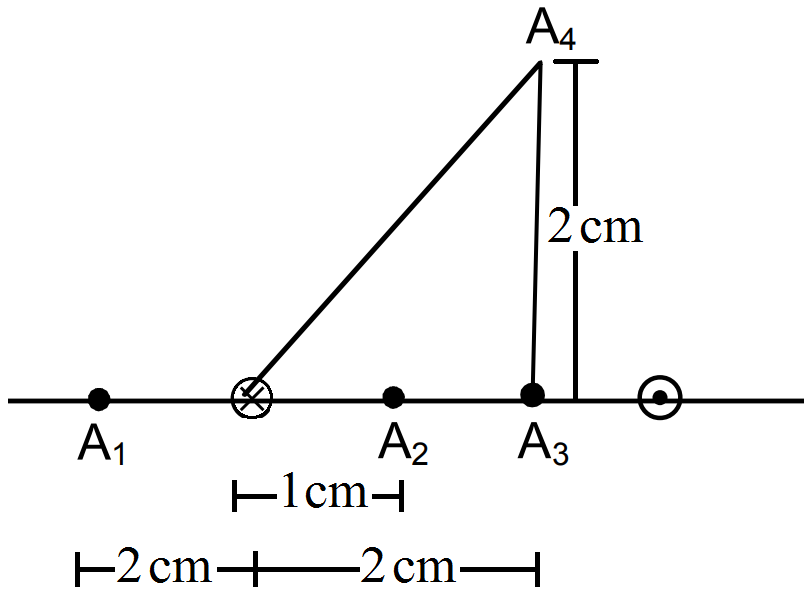
Figure shows two parallel wires separated by a distance of 4.0cm and carrying equal currents of 10A along opposite directions. Find the magnitude of the magnetic field B at the points A1, A2, A3 and A4.

Three particles of masses 1.0kg, 2.0kg and 3.0kg are placed at the corners A, B and C respectively of an equilateral triangle ABC of edge 1m. Locate the centre of mass of the system.
Figure shows a situation similar to the previous problem. All parameters are the same except that a battery of emf $\in$ and a variable resistance R are connected between O and C. The connecting wires have zero resistance. No external force is applied on the rod (except gravity, forces by the magnetic field and by the pivot). In what way should the resistance R be changed so that the rod may rotate with uniform angular velocity in the clockwise direction? Express your answer in terms of the given quantities and the angle $\theta$ made by the rod OA with the horizontal.

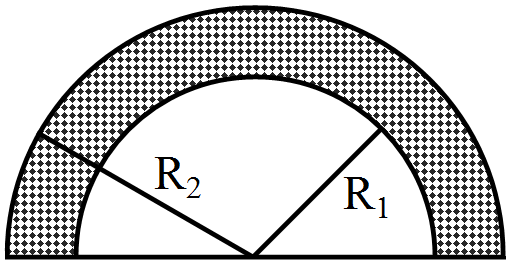
Find the centre of mass of a uniform plate having semicircular inner and outer boundaries of radii R1 and R2.

A pendulum clock gives correct time at 20°C at a place where g = 9.800m s-2. The pendulum consists of a light steel rod connected to a heavy ball. It is taken to a different place where g = 9.788m s-2. At what temperature will it give correct time ? Coefficient of linear expansion of steel = 12 × 10-6 °C-1.
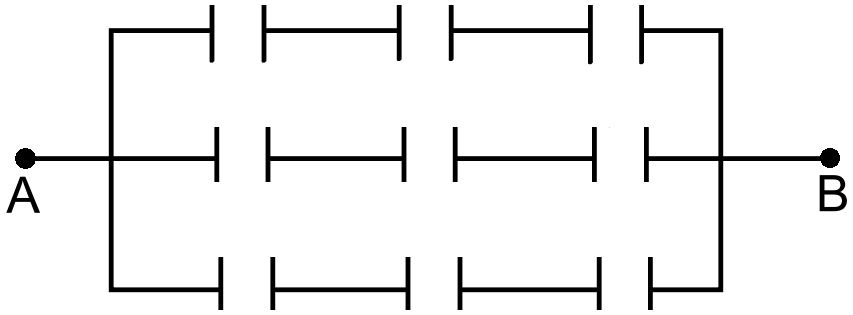
Each of the capacitors shown in figure has a capacitance of $2\mu\text{F}.$ Find the equivalent capacitance of the assembly between the points A and B. Suppose, a battery of emf 60 volts is connected between A and B. Find the potential difference appearing on the individual capacitors.

A paperweight in the form of a hemisphere of radius 3.0cm is used to hold down a printed page. An observer looks at the page vertically through the paperweight. At what height above the page will the printed letters near the centre appear to the observer?
A solenoid 60 cm long and of radius 4.0 cm has 3 layers of windings of 300 turns each. A 2.0 cm long wire of mass 2.5 g lies inside the solenoid (near its centre) normal to its axis; both the wire and the axis of the solenoid are in the horizontal plane. The wire is connected through two leads parallel to the axis of the solenoid to an external battery which supplies a current of 6.0 A in the wire. What value of current (with appropriate sense of circulation) in the windings of the solenoid can support the weight of the wire? g = 9.8 m s–2.