Question
A circular wire-loop of radius a carries a total charge Q distributed uniformly over its length. A small length dL of the wire is cut off. Find the electric field at the centre due to the remaining wire.

Answer

$\frac{\text{Charge}}{\text{Unit length}}=\frac{\text{Q}}{2\pi\text{a}}=\lambda;$ Charge of $\text{d}\ell=\frac{\text{Qd}\ell}{2\pi\text{a}}\text{C}$

Initially the electric field was ‘0’ at the centre. Since the element ‘dℓ’ is removed so, net electric field must $\frac{\text{K}\times\text{q}}{\text{a}^2}$

Where q = charge of element $\text{d}\ell$

$\text{E}=\frac{\text{Kq}}{\text{a}^2}$

$=\frac{1}{4\pi\in_0}\times\frac{\text{Q}\text{d}\ell}{2\pi\text{a}}\times\frac{1}{\text{a}^2}$

$=\frac{\text{Qd}\ell}{8\pi^2\in_0\text{a}^3}$

Need a full question paper?

Generate a complete, print-ready paper with questions like this in minutes — across 16+ boards, with answer keys.
Start Generating Free

Similar questions

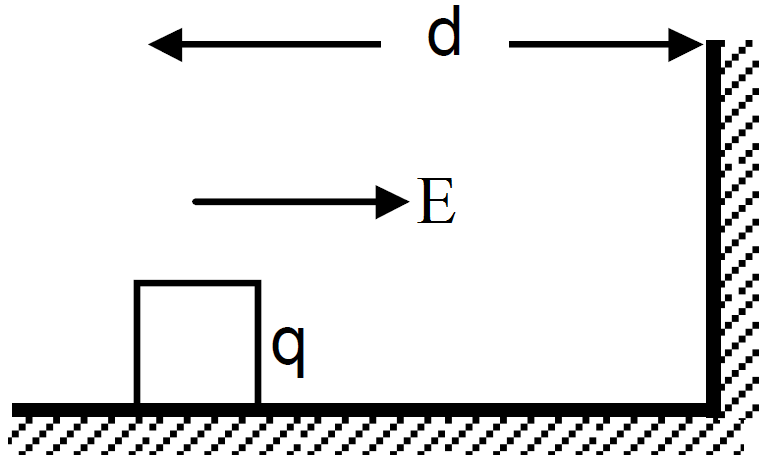
A block of mass m containing a net positive charge q is placed on a smooth horizontal table which terminates in a vertical wall as shown in figure. The distance of the block from the wall is d. A horizontal electric field E towards right is switched on. Assuming elastic collisions (if any) find the time period of the resulting oscillatory motion. Is it a simple harmonic motion?

The angular magnification of a system is less than one. Does it mean that the image formed is inverted?
As temperature increases, the viscosity of liquids decreases considerably. Will this decrease the resistance of an electrolyte as the temperature increases?
Suppose the amplitude of a simple pendulum having a bob of mass m is $\theta_0.$ Find the tension in the string when the bob is at its extreme position.
The distance of a galaxy is of the order of 1025m. Calculate the order of magnitude of time taken by light to reach us from the galaxy.
A particle moves from a point $\vec{\text{r}}_1=(2\text{m})\vec{\text{i}}+(3\text{m})\vec{\text{j}}$ to another point $\vec{\text{r}}_2=(3\text{m})\vec{\text{i}}+(2\text{m})\vec{\text{j}}$ during which a certain force $\vec{\text{F}}=(5\text{N})\vec{\text{i}}+(5\text{N})\vec{\text{j}}$ acts on it. Find the work done by the force on the particle during the displacement.
A string, fixed at both ends, vibrates in a resonant mode with a separation of 2.0cm between the consecutive nodes. For the next higher resonant frequency, this separation is reduced to 1.6cm. Find the length of the string.
What is meant by 'superheated water' and 'super cooled vapour'? Do these states of water lie on its P-V-T surface? Give some practical applications of these states of water.
A steel cable with a radius of 1.5cm supports a chairlift at a ski area. If the maximum stress is not to exceed 108N m-2, what is the maximum load the cable can support?
Necessary condition for sustained interference write down.