Question
a. Derive an expression for the energy stored in a parallel plate capacitor of capacitance C when charged up to voltage V. How is this energy stored in the capacitor?
b. A capacitor of capacitance $1 \mu F$ is charged by connecting a battery of negligible internal resistance and emf 10 V across it. Calculate the amount of charge supplied by the battery in charging the capacitor fully.
Answer

a. Work done in adding a charge $dq = dW$
$\begin{array}{l}= Vdq \\ =\frac{q}{c} d q\end{array}$
$\therefore$ Total Amount of work(W) in charging a capacitor
$\begin{array}{l} W =\int d W=\frac{1}{C} \int_0^Q q d q \\ W=\frac{Q^2}{2 C} \\ =\frac{(C V)^2}{2 C}=\frac{1}{2} C V^2\end{array}$
The electrostatic Energy/ potential energy is stored in the electric field between the plates.
b. $C =1 \mu F=1 \times 10^{-6} F ; V =10$ volt
$\begin{array}{l}Q=C V \\ =1 \times 10^{-6} \times 10 \\ =10^{-5} \text { coulomb }\end{array}$
hence, the amount of charge supplied by the battery in charging the capacitor fully is $10^{-5}$ coulomb.

Need a full question paper?

Generate a complete, print-ready paper with questions like this in minutes — across 16+ boards, with answer keys.

Start Generating Free

Similar questions

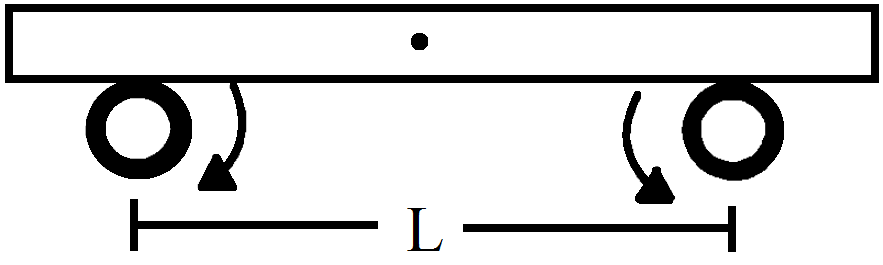
A uniform plate of mass M stays horizontally and symmetrically on two wheels rotating in opposite directions figure The separation between the wheels is L. The friction coefficient between each wheel and the plate is N. Find the time period of oscillation of the plate if it is slightly displayed along its length and released.

Two waves, each having a frequency of 100Hz and a wavelength of 2.0cm, are travelling in the same direction on a string. What is the phase difference between the waves,
  1. If the second wave was produced 0.015s later than the first one at the same place.
  2. If the two waves were produced at the same instant but the first one was produced a distance 4.0cm behind the second one?
  3. If each of the waves has an amplitude of 2.0mm, what would be the amplitudes of the resultant waves in part (a) and (b)?
  1. With the help of a suitable ray diagram, derive the mirror formula for a concave mirror.
  2. The near point of a hypermetropic person is 50 cm from the eye. What is the power of the lens required to enable the person to read clearly a book held at 25 cm from the eye?
The electric field associated with a light wave is given by $\text{E}=\text{E}_0\sin[(1.57\times10^7\text{m}^{-1})(\text{x}-{\text{ct}})].$ Find the stopping potential when this light is used in an experiment on photoelectric effect with the emitter having work function 1.9eV.
The equation of a wave travelling on a string stretched along the X-axis is given by-

$\text{y}=\text{A}\text{e}^{-\Big(\frac{\text{x}}{\text{a}}+\frac{\text{t}}{\text{T}}\Big)^2}.$

  1. Write the dimensions of A, a and T.
  2. Find the wave speed.
  3. In which direction is the wave. travelling?
  4. Where is the maximum of the pulse located at t = T? at t = 2T?
  1. Draw the circuit diagrams of a p-n junction diode in (i) forward bias, (ii) reverse bias. How are these circuits used to study the V - I characteristics of a silicon diode? Draw the typical V - I characteristics.
  2. What is a light emitting diode (LED)? Mention two important advantages of LEDs over conventional lamps.
A charge Q is uniformly distributed on a thin spherical shell. What is the field at the centre of the shell? If a point charge is brought close to the shell, will the field at the centre change? Does your answer depend on whether the shell is conducting or nonconducting?
Find the total heat produced in the loop of the previous problem during the interval 0 to 30s if the resistance of the loop is $4.5\text{m}\Omega.$
A particle executes a simple harmonic motion of amplitude 1.0cm along the principal axis of a convex lens of focal length 12cm. The mean position of oscillation is at 20cm from the lens. Find the amplitude of oscillation of the image of the particle.
A convex lens of focal length 20cm and a concave lens of focal length 10cm are placed 10cm apart with their principal axes coinciding. A beam of light travelling parallel to the principal axis and having a beam diameter 5.0mm, is incident on the combination. Show that the emergent beam is parallel to the incident one. Find the beam diameter of the emergent beam.