Question
(a) Derive the expression for the magnetic energy stored in a evil.
(b) Derive the expression for the mutual inductance between two plane coils.

Answer

(a) Magnetic Energy Stored in a coil: When a current is established in an inductor (coil) by connected, a source of emf across its ends then an emf is induced in it due to self induction. This emf opposses the rise of current through the coil. Hence work has to be done by the current to get its steady value against the induced emf.
The energy for this work is obtained from the source of emf connected across the coil and this energy is stored as magnetic energy in the coil.
Let dW be the work done in establishing a current I in the coil in time dt.
Then, work $dW = eIdt$, where e is the induced emf
$dW = [L(\frac{dI}{dt})]Idt = LIdI$ ($\because$ $e = L\frac{dI}{dt}$)
Total work done in maintaining a steady current $I_{0}$ in the coil is given by
$W = \int dW = \int_{0}^{I_{0}} LIdI = L[\frac{I^{2}}{2}]_{0}^{I_{0}} = \frac{1}{2}LI_{0}^{2}$
Magnetic Energy stored in the coil :
$U=W \Rightarrow U=\frac{1}{2}LI_{0}^{2}$
(b) Mutual Inductance between two plane coils:
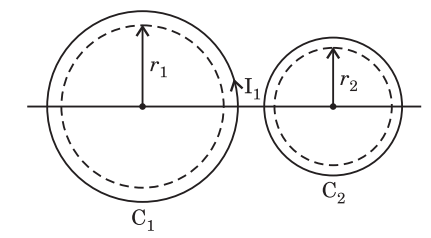
In adjoining figure two plane coils C1 and C2 are kept coaxially near each other. Let N1 be the number of turns in primary and N2 in secondary coil. If I1 current is flowing in primary coil, the magnetic field at the centre of the coil is given by :
Image
$B _1=\frac{\mu_0 N_1 I _1}{2 r_1}$
where $r_1$ is the radius of the primary coil. The magnetic field lines are treating uniformerly into the secondary coil. Hence magnetic flux passing through each turn of secondary coil will be $\Phi_2= B _1 \times A _2$
where $A_2$ = Area of cross-section of secondary coil =
$\pi r_2^2$ in which $r_2$ is the radius of the secondary coil
$\therefore \quad \Phi_2=\left(\frac{\mu_0 N_1 I _1}{2 r_1}\right) \times \pi r_2^2$
or $\Phi_2=\left(\frac{\mu_0 \pi r_2^2}{2 r_1}\right) N _1 I _1$
But coefficient inductance between these two coils is given by
$M =\frac{ N _2 \Phi_2}{ I _1}$
$\therefore \quad M =\frac{ N _2\left(\frac{\mu_0 \pi r_2^2}{2 r_1}\right) \cdot N _1 I _1}{ I _1}$
$\Rightarrow \quad M =\left(\frac{\mu_0 \pi r_2^2}{ 2 r_1}\right) N _1 N _2$ ...(1)
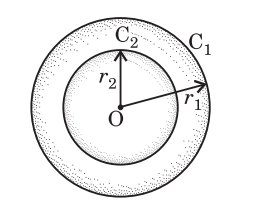
If the two coils are placed concentrically as shown in adjoining figure and $I_1$ be the current passed through coil C1 then magnetic field at the centre of this coil will be given by :
Image
$B _1=\frac{\mu_0 N_1 I _1}{2 r_1}$
where, N1= Number of turns in this coil C1
r₁ = Radius of this coil C1
Since coil C2 is small, the magnetic field B1 may be considered uniform throughout the area of cross-section of C2.
∴ Magnetic flux linked with the coil $C _2$ is given by :
$\Phi_2= B _1 A_2=\frac{\mu_0 N_1 I _1}{2 r_1} \times \pi r_2^2$
$\Rightarrow \quad \Phi_2=\left(\frac{\mu_0 \pi r_2^2}{2 r_1}\right) N _1 I _1$
where, r2 = Radius of inner coil C2.
But coefficient of mutual induction between these two coils is given by :
$M =\frac{ N _2 \Phi_2}{ I _1}=\frac{ N _2\left(\frac{\mu_0 \pi r_2^2}{2 r_1}\right) N _1 I _1}{ I _1}$
$\Rightarrow \quad M =\left(\frac{\mu_0 \pi r_2^2}{ 2 r _1}\right) N _1 N _2$ ...(2)
where, N2 = Number of turns in the inner coil. Thus formula for M is the same as formula (1).
In this way formula for M in both the situation is the same.

Need a full question paper?

Generate a complete, print-ready paper with questions like this in minutes — across 16+ boards, with answer keys.
Start Generating Free

Similar questions

Three capacitors having capacitances $20\mu\text{F},\ 30\mu\text{F}$ and $40\mu\text{F}$ are connected in series with a 12V battery. Find the charge on each of the capacitors. How much work has been done by the battery in charging the capacitors?
How many time constants will elapse before the energy stored in the capacitor reaches half of its equilibrium value in a charging RC circuit?
Lenses are constructed by a material of refractive index $1.50.$ The magnitude of the radii of curvature are $20\ cm$ and $30\ cm$. Find the focal lengths of the possible lenses with the above specifications.
Draw a ray diagram to show the formation of real image of the same size as that of the object placed in front of a converging lens. Using this ray diagram establish the relation between u, v and f for this lens.
$i$. Define the capacitance of a capacitor. Obtain the expression for the capacitance of a parallel plate capacitor in vacuum in terms of plate area $A$ and separation d between the plates.
$ii.$ A slab of material of dielectric constant $k$ has the same area as the plates of a parallel plate $\frac{3 d}{4}$ capacitor but has a thickness $ -$. Find the ratio of the capacitance with dielectric inside it to its capacitance without the dielectric.
A coil of inductance $0.50H$ and resistance $100\Omega $ is connected to a $240V, 50Hz \ \ ac $supply.
  1. What is the maximum current in the coil?
  2. What is the time lag between the voltage maximum and the current maximum?
Is it possible that in a Coolidge tube characteristic $\text{L}_\alpha \ X-$rays are emitted but not $\text{K}_\alpha \  X-$rays?
A long solenoid of radius $2\ cm$ has $100\ turns/cm$ and carries a current of $5A.$ A coil of radius $1\ cm$ having $100$ turns and a total resistance of $2\Omega$ is placed inside the solenoid coaxially. The coil is connected to a galvanometer. If the current in the solenoid is reversed in direction, find the charge flown through the galvanometer.
An emf $\varepsilon=100 \sin 314 t$ is applied across a pure capacitor of $637\ \mu F$. Find
$i.$ the instantaneous current $I$
$ii.$ instantaneous power $P$
$ii.$ the frequency of power and
$iii.$ the frequency of power and
$iv.$ the maximum energy stored in the capacitor.
The work function of caesium metal is $2.14 eV$. When light of frequency $6 \times 10^{14 }Hz$ is incident on the metal surface, photoemission of electrons occurs. What is the
  1. Maximum kinetic energy of the emitted electrons,
  2. Stopping potential, and
  3. Maximum speed of the emitted photoelectrons?