Question
A dietician has to develop a special diet using two foods P and Q. Each packet (containing 30g) of food P contains 12 units of calcium, 4 units of iron, 6 units of cholesterol and 6 units of vitamin A. Each packet of the same quantity of food Q contains 3 units of calcium, 20 units of iron, 4 units of cholesterol and 3 units of vitamin A. The diet requires atleast 240 units of calcium, atleast 460 units of iron and at most 300 units of cholesterol. How many packets of each food should be used to minimise the amount of vitamin A in the diet? What is the minimum Amount of vitamin A.
Answer

Let x packets of food P and y packets of food Q be used to make the diet.

Each packet of food P contains 6 units of vitamin A and each packet of food Q contains 3 units of vitamin A.

Therefore, x packets of food P and y packets of food Q contains (6x + 3y) units of vitamin A.

Since each packet of food P contains 12 units of calcium and each packet of food Q contains 3 units of calcium, therefore, x packets food P and y packets of food Q will contain (12x + 4y) units of calcium.

But, the diet should contain atleast 240 units of calcium.

$\therefore12\text{x}+3\text{y}\geq240$

$\Rightarrow4\text{x}+\text{y}\geq80$

Similarly, x packets of food P and y packets of food Q will contain (4x + 207) units of iron. But, the diet should contain atleast 460 units of iron.

$\therefore4\text{x}+20\text{y}\geq460$

$\Rightarrow\text{x}+5\text{y}\geq115$

Also, x packets of food P and y packets of food Q will contain (6x + 4y) units of cholesterol.

But, the diet should contain atmost 300 units of cholesterol.

$\therefore6\text{x}+4\text{y}\leq300$

$3\text{x}+2\text{y}\leq150$

Thus, the given linear programming problem is

Minimise Z = 6x + 3y

subject to the constraints

$4\text{x}+\text{y}\geq80$

$\text{x}+5\text{y}\geq115$

$3\text{x}+2\text{y}\leq150$

$\text{x},\text{y}\geq0$

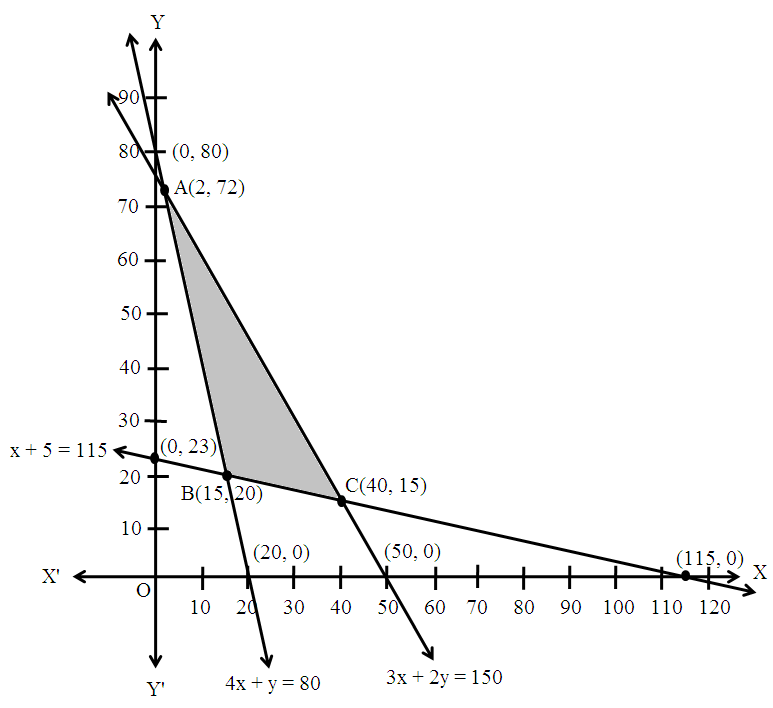
The feasible region determined by the given constraints can be diagrammatically represented as,


The coordinates of the corner points of the feasible region are A(2, 72), B(15, 20) and C(40, 15).

The value of the objective function at these points are given in the following table.
Corner Point
Z = 6x + 3y
(2, 72)
6 × 0 + 3 × 72 = 216
(15, 20)
6 × 15 + 3 × 20 = 150
(40, 15) 6 × 40 + 3 × 15 = 285
The smallest value of Z is 150 which is obtained at x = 15 and y = 20.

It can be verified that the open half-plane represented by $6\text{x}+3\text{y}\leq150$ has no common points with the feasible region.

Thus, 15 packets of food P and 20 packets of food Q should be used to minimise the amount of vitamin A in the diet.

Hence, the minimum amount of vitamin A is 150 units.

Need a full question paper?

Generate a complete, print-ready paper with questions like this in minutes — across 16+ boards, with answer keys.

Start Generating Free

Similar questions

Solve the following differential equation:
$\text{x}\frac{\text{dy}}{\text{dx}}=\text{y}-\text{x}\cos^2\Big(\frac{\text{y}}{\text{x}}\Big)$
Solve $\text{y}+\frac{\text{d}}{\text{dx}}(\text{xy})=\text{x}(\sin\text{x}+\log\text{x}).$
Evaluate the following integrals:
$\int\limits_{\frac{1}{3}}^{1}\frac{\big(\text{x}-\text{x}^3\big)^{\frac{1}{3}}}{\text{x}^4}\text{ dx}$
Show that the lines $\frac{\text{x}+4}{3}=\frac{\text{y}+6}{5}=\frac{\text{z}-1}{-2}$ and 3x - 2y + z + 5 = 0 = 2x + 3y + 4z - 4 intersect. Find the equation of the plane in which they lie and also their of intersection.
A person buys a lottery ticket in 50 lotteries, in each of which his chance of winning a prize is $\frac{1}{100}.$ What is the probability that he will win a prize.
  1. at least once.
  2. exactly once.
  3. at least twice.
At what points will be tangents to the curve $y = 2x^3 - 15x^2 + 36x - 21$ be parallel to $x-$axis$?$ Also, find the equations of the tangents to the curve at these points.
A manufacturing company makes two types of teaching aids A and B of Mathematics for class XII. Each type of A requires 9 labour hours of fabricating and 1 labour hour for finishing. Each type of B requires 12 labour hours for fabricating and 3 labour hours for finishing. For fabricating and finishing, the maximum labour hours available per week are 180 and 30 respectively. The company makes a profit of A and 80 on each piece of type 120 on each piece of type B. How many pieces of type A and type B should be manufactured per week to get a maximum profit? Make it as an LPP and solve graphically. What is the maximum profit per week?
Prove that:
$\begin{vmatrix}\text{a}-\text{b}-\text{c}&2\text{a}&2\text{a}\\2\text{b}&\text{b}-\text{c}-\text{a}&2\text{b}\\2\text{c}&2\text{c}&\text{c}-\text{a}-\text{b} \end{vmatrix}=(\text{a}+\text{b}+\text{c})^3$
If $x^{13} y^7 = (x + y)^{20}$​​​​​​​, prove that $\frac{\text{dy}}{\text{dx}}=\frac{\text{y}}{\text{x}}$
Without expanding, show that the values of the following determinant are zero:
$\begin{vmatrix}1&43&6\\7&35&4\\3&17&2\end{vmatrix}$