Question
A dimensionless quantity:
  1. Never has a unit.
  2. Always has a unit
  3. May have a unit.
  4. Does not exist.

Answer

  1. May have a unit.
Explanation:
Dimensionless quantities may have units.

Need a full question paper?

Generate a complete, print-ready paper with questions like this in minutes — across 16+ boards, with answer keys.
Start Generating Free

Similar questions

Assertion :   The stars twinkle while the planets do not.
Reason     :  The stars are much bigger in size than the planets.(a) If both assertion and reason are true and the reason is the correct explanation of the assertion.(b) If both assertion and reason are true but reason is not the correct explanation of the assertion.(c) If assertion is true but reason is false.(d) If the assertion and reason both are false.


A parallel$-$plate capacitor has plates of unequal area. The larger plate is connected to the positive terminal of the battery and the smaller plate to its negative terminal. Let $Q_+$ and $Q_-$ be the charges appearing on the positive and negative plates respectively:
The neutral temperature of a thermocouple is 350℃ when the cold junction is at 0℃ When the cold junction is immersed in a bath of 30℃, the inversion temperature is (a) 700℃(b) 600℃(c) 350℃(d) 670℃
       
If in a logic gate output (Y) is obtained by the product of its both inputs (A, B) then the gate is :
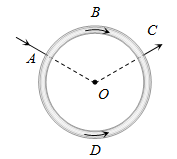
A uniform wire is bent in the form of a circle of radius $R. A$ current $I$ enters at $A$ and leaves at $C$ as shown in the figure : If the length $ABC$ is half of the length $ADC,$ the magnetic field at the centre $O$ will be
The Electric field at a point is:
The value of scattering angle of alpha particle for minimum value of impact parameter is-
When stopping potential is applied in an experiment on photoelectric effect, no photocurrent is observed. This means that:
  1. The emission of photoelectrons is stopped.
  2. The photoelectrons are emitted but are reabsorbed by the emitter metal.
  3. The photoelectrons are accumulated near the collector plate.
  4. The photoelectrons are dispersed from the sides of the apparatus.
If $E$ is the electric field intensity of an electrostatic field, then the electrostatic energy density is proportional to
The bending of light as it passes from one medium into another is commonly known as: