MCQ
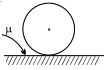
$A$ disc of radius $r$ is rotating about its centre with an angular speed $\omega_0$. It is gently placed on a rough horizontal surface. After what time it will be in pure rolling ?
  • A
    $\frac{{{\omega _0}r}}{{2\mu g}}$
  • $\frac{{{\omega _0}r}}{{3\mu g}}$
  • C
    $\frac{{{\omega _0}r}}{{\mu g}}$
  • D
    $\frac{3}{2}\frac{{{\omega _0}r}}{{\mu g}}$
Answer

Correct option: B.
$\frac{{{\omega _0}r}}{{3\mu g}}$
b
The acceleration due to friction is given as,

$a=\frac{f}{m}$

$=\frac{\mu m g}{m}$

$=\mu g$

Angular acceleration due to friction is given as,

$\alpha=\frac{\tau}{I}$

$=\frac{f R}{\frac{1}{2} m R^{2}}$

$=\frac{2 \mu g}{R}$

The final angular velocity is given as,

$\omega=\omega_{0}-\alpha t$

$\omega=\omega_{0}-\frac{2 \mu g t}{R}$

The final velocity is given as,

$v=a t$

$v=\mu g t$

we know that,

$v=R \omega$

$\mu g t=R\left(\omega_{0}-\frac{2 \mu g t}{R}\right)$

$t=\frac{\omega_{0} R}{3 \mu g}$

Thus, the time is $\frac{\omega_{0} R}{3 \mu g}$ after that the disc will be in pure rolling.

Need a full question paper?

Generate a complete, print-ready paper with questions like this in minutes — across 16+ boards, with answer keys.

Start Generating Free

Similar questions

$n$ identical waves each of intensity $I_0$ interfere with each other. The ratio of maximum intensities if the interference is $(i)$ coherent and $(ii)$ incoherent is :
A particle of charge per unit mass $\alpha$ is released from origin with a velocity $\bar{v}=v_0 \vec{i}$ in a uniform magnetic field $\bar{B}=-B_0 \hat{k}$. If the particle passes through $(0, y, 0)$ then $y$ is equal to
In a common emitter transistor amplifier, an input signal of $10$  $mV$ is applied. Due to this signal, the change in base current is $50$  $μA$ and the corresponding change in collector current is $5$  $mA$. If the load resistance in the collector emitter circuit is $5\ k\Omega$ the change in output voltage will be .....$V$
Which of the following statements is true/correct
The eccentricity of earth's orbit is $0.0167$. The ratio of its maximum speed in its orbit to its minimum speed is
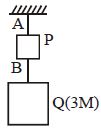
Wires $A$ and $B$ are connected with blocks $P$ and $Q$ as shown. The ratio of lengths, radii and Young's modulus of wires $A$ and $B$ are $r, 2r$ and $3r$ respectively ($r$ is a constant). Find the mass of block $P$ if ratio of increase in their corresponding lengths is $1/6r^2$. The mass of block $Q$ is $3M$.
If $x = at + b{t^2}$, where $x$ is the distance travelled by the body in kilometres while $t$ is the time in seconds, then the units of $b$ are
A seconds pendulum clock has a steel wire. The clock shows correct time at $25^{\circ} C$. .......... $s$ time does the clock lose or gain, in one week, when the temperature is increased to $35^{\circ} C$ ? $\left(\alpha_{\text {toel }}=1.2 \times 10^{-5} /{ }^{\circ} C \right)$
To obtain $3\,\mu F$ capacity from three capacitors of $2\,\mu F$ each, they will be arranged
Assertion : When current through a bulb decreases by $0.5\%$, the glow of bulb decreases by $1\%$.

Reason : Glow (Power) which is directly proportional to square of current.