Question
A disc rotates about its axis with a constant angular acceleration of 4rad/s2. Find the radial and tangential accelerations of a particle at a distance of 1cm from the axis at the end of the first second after the disc starts rotating.

Answer

$\text{t}=1\text{sec},\ \text{r}=1\text{cm}=0.01\text{m}$
$\alpha=4\text{rad/s}^2$
Therefore $\omega=\alpha\text{t}=4\text{rad/s}$
Therefore radial acceleration,
$\text{A}_{\text{n}}=\omega^2\text{r}=0.16\text{m/s}^2=16\text{cm/s}^2$
Therefore tangential acceleration,
$\text{a}_{\text{r}}=0.04\text{m/s}^2=4\text{cm/s}^2.$

Need a full question paper?

Generate a complete, print-ready paper with questions like this in minutes — across 16+ boards, with answer keys.
Start Generating Free

Similar questions

A 10m wide spacecraft moves through the interstellar space at a speed 3 × 10⁷m/s-1. A magnetic field B = 3 × 10⁻¹⁰T exists in the space in a direction perpendicular to the plane of motion. Treating the spacecraft as a conductor, calculate the emf induced across its width.
Let $\overrightarrow{\text{A}}=5\vec{\text{i}}-4\vec{\text{j}}$ and $\overrightarrow{\text{B}}=-7.5\vec{\text{i}}+6\vec{\text{j}}.$
  1. Do we have $\overrightarrow{\text{B}}\text{k}\vec{\text{A}}?$
  2. Can we say $\frac{\overrightarrow{\text{B}}}{\overrightarrow{\text{A}}}=\text{k}?$
Earth's radius is about 6370km. A mass of 20kg is taken to a height of 160km above the earth's surface.
  1. What is the mass of the objects at that height?
  2. How much does the object weigh at this height?
A truck and a car moving with the same kinetic energies (KE) on a straight road. Their engines are simultaneously switched off. Which one will stop at a lesser distance?
A gas is enclosed in a cylindrical vessel fitted with a frictionless piston. The gas is slowly heated for some time. During the process, 10J of heat is supplied and the piston is found to move out 10cm. Find the increase in the internal energy of the gas. The area of cross section of the cylinder = 4cm2 and the atmospheric pressure = 100kPa.
Suppose you have three resistors of $20\Omega,50\Omega$ and $100\Omega.$ What minimum and maximum resistance can you obtain from these resistors?
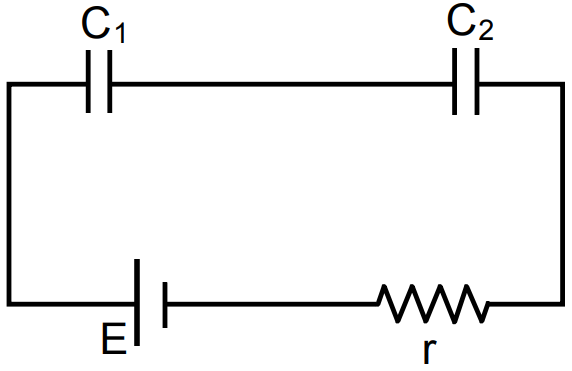
Consider the situation shown in figure. The switch is closed at t = 0 when the capacitors are uncharged. Find the charge on the capacitor C1 as a function of time t.

A conducting circular loop of area 1mm2 is placed coplanarly with a long, straight wire at a distance of 20cm from it. The straight wire carries an electric current which changes from 10A to zero in 0.1s. Find the average emf induced in the loop in 0.1s.
The pendulum of a clock is replaced by a spring-mass system with the spring having spring constant 0.1N/m. What mass should be attached to the spring?
A sample of 0.177g of an ideal gas occupies 1000cm3 at STP. Calculate the rms speed of the gas molecules.