MCQ
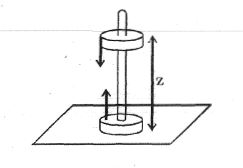
A donut-shaped permanent magnet (magnetization parallel to the axis) can slide frictionlessly on a vertical rod. Treat the magnets as  dipoles with mass $m_d$ and dipole moment $M$ . When we put two back to back magnets on the rod the upper one will float. At what height $z$ does it float?
  • A
    ${\left[ {\frac{{2{\mu _0}{M^2}}}{{3\pi {m_d}g}}} \right]^{1/4}}$
  • B
    ${\left[ {\frac{{6{\mu _0}{M^2}}}{{\pi {m_d}g}}} \right]^{1/4}}$
  • ${\left[ {\frac{{3{\mu _0}{M^2}}}{{2\pi {m_d}g}}} \right]^{1/4}}$
  • D
    ${\left[ {\frac{{{\mu _0}{M^2}}}{{6\pi {m_d}g}}} \right]^{1/4}}$
Answer

Correct option: C.
${\left[ {\frac{{3{\mu _0}{M^2}}}{{2\pi {m_d}g}}} \right]^{1/4}}$
c
Force between two magnetic dipoles parallel to each. $=\vec{\mathrm{F}}_{\mathrm{ab}}=\frac{3 \mu_{0}}{2 \pi r^{4}}\left(\vec{\mathrm{m}}_{\mathrm{e}} \overrightarrow{\mathrm{m}}_{\mathrm{b}}\right) \hat{\mathrm{r}}$

$|\overrightarrow{\mathrm{F}}|=\mathrm{mg}$

$\therefore \frac{3 \mu_{0}}{2 \pi r^{4}}\left(\mathrm{m}_{\mathrm{b}} \mathrm{m}_{\mathrm{a}}\right)=\mathrm{mg}$

$r=\left(\frac{3 \mu_{0} m^{2}}{2 \pi m g}\right)^{1 / 4}$

Need a full question paper?

Generate a complete, print-ready paper with questions like this in minutes — across 16+ boards, with answer keys.

Start Generating Free

Similar questions

$A$ light of wavelength $6300Å$ shine on a two narrow slits separated by a distance $1.0\, mm$ and illuminates a screen at $a$ distance $1.5\, m$ away. When one slit is covered by a thin glass of refractive index $1.8$ and other slit by a thin glass plate of refractive index $\mu$ , the central maxima shifts by $6^o$. Both plates have same thickness of $0.5\, mm$. The value of refractive index $\mu$ of the plate is
A thin plano-convex lens acts like a concave mirror of focal length 0.2 m when silvered from its plane surface. The refractive index of the material of the lens is 1.5. The radius of curvature of the convex surface of the lens will be
A capacitor of $10 \mu \mathrm{F}$ capacitance whose plates are separated by $10 \mathrm{~mm}$ through air and each plate has area $4 \mathrm{~cm}^2$ is now filled equally with two dielectric media of $\mathrm{K}_1=2, \mathrm{~K}_2=3$ respectively as shown in figure. If new force between the plates is $8 \mathrm{~N}$. The supply voltage is . . . .. . .V.
A semiconducting device is connected in a series circuit with a battery and a resistance. A current is found to pass through the circuit. If the polarity of the battery is reversed, the current drops to almost zero. the device may be :
A lamp is hanging along the axis of a circular table of radius $r.$ At what height should the lamp be placed above the table, so that the illuminance at the edge of the table is $\frac{1}{8}$ of that at its center
The stopping potential ($v_0$) 
A metallic ring of radius $a$ and resistance $R$ is held fixed with its axis along a spatially uniform magnetic field whose magnitude is $B_0 \sin \omega t$. Gravity is neglected. Then,
Consider the following statements $\mathrm{A}$ and $\mathrm{B}$ and identify the correct answer:

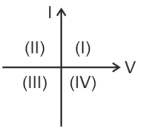
$A$. For a solar-cell, the $I-V$ characteristics lies in the $IV$ quadrant of the given graph.

$B$. In a reverse biased $p n$ junction diode, the current measured in $(\mu \mathrm{A})$, is due to majority charge carriers.

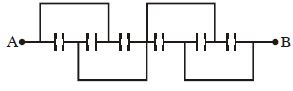
All capacitors used in the diagram are identical and each is of capacitance $C$. Then the effective capacitance between the points $A$ and $B$ is
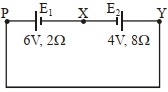
A cell $E _{1}$ of $emf 6 V$ and internal resistance $2 \Omega$ is connected with another cell $E _{2}$ of $emf 4 V$ and internal resistance $8 \Omega$ (as shown in the figure). The potential difference across points $X$ and $Y$ is............ $V$