Question
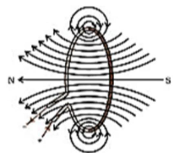
a. Draw the pattern of magnetic field lines produced by a current carrying circular loop showing the direction of current in the loop and the direction of the magnetic field lines.
b. State the rule which can be applied to know the direction of magnetic field lines in the above case.
Need a full question paper?

Generate a complete, print-ready paper with questions like this in minutes — across 16+ boards, with answer keys.

Start Generating Free

Similar questions

A man holds a spherical shaving mirror of radius of curvature 60cm, and focal length 30cm, at a distance of 15cm, from his nose. Find the position of image, and calculate the magnification.
Why does the sun appear reddish early in the morning? Will this phenomenon be observed by an observer on the moon? Justify your answer with a reason.
Two coils A and B of insulated wire are kept close to each other. Coil A is connected to a galvanometer while coil B is connected to a battery through a key. What would happen if:
  1. A current is passed through coil B by plugging the key?
  2. He current is stopped by removing the plug from the key?
Explain your answer mentioning the name of the phenomenon involved.
Consider a circular loop of wire lying in the plane of the table. Let the current pass through the loop clockwise. Apply the right-hand rule to find out the direction of the magnetic field inside and outside the loop.
When an object is placed 10cm in front of lens A, the image is real, inverted, magnified and formed at a great distance. When the same object is placed 10cm in front of lens Bthe image formed is real, inverted and same size as the object:
  1. What is the focal length of lens A?
  2. What is the focal length of lens B?
  3. What is the nature of lens A?
  4. What is the nature of lens B?
What is the principle of an electric motor? Name some of the devices in which electric motors are used.
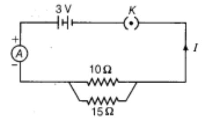
Study the following circuit and answer the questions that follows:
Image
i. How much current is flowing through
a. $10 \Omega$ and
b. $15 \Omega$ resistor?
ii. What is the ammeter reading?
A convex lens of focal length 20cm can produce a magnified virtual as well as real image. Is this a correct statement? If yes, where shall the object be placed in each case for obtaining these images?
Between which two points of concave mirror should an object be placed to obtain a magnification of:
  1. −3
  2. +25
  3. −0.4
Draw labelled ray diagrams to show the formation of images in cases (i) and (ii)above (The diagrams may not be according to scale).