Question
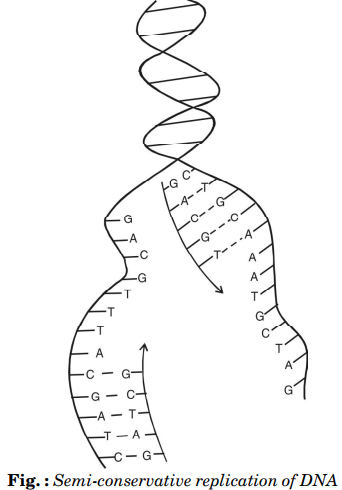
(a) Explain the process of DNA replication in prokaryotes.
(b) Name the phase in the cell cycle in which DNA replication takes place in the cell. What if after DNA replication there is no cell division in a cell?
Need a full question paper?

Generate a complete, print-ready paper with questions like this in minutes — across 16+ boards, with answer keys.

Start Generating Free

Similar questions

Answer the following questions.
Explain the events taking place at the time of fertilisation of an ovum in a human female.
What is geitonogamy? Give an example. How does geitonogamy differ from xenogamy in plants?
Describe the experiment carried out by Hershey and Chase. Write the conclusion they arrived at.
An organism is able to survive on a culture medium, containing nutrient A, by the enzyme-catalysed reactions.
$\text{A}\xrightarrow{\ \ \ \text{p}\ \ \ }\text{B}\xrightarrow{\ \ \ \text{q}\ \ \ }\text{C}\xrightarrow{\ \ \ \text{r}\ \ \ }\text{D}$
A mutant organism failed to survive on this medium, but grew well when nutrient B was added to it.
  1. Which gene of this mutant organism is defective?
  2. What does such a condition indicate of ?
  3. Mention the major components and their functions in an operon.
  4. Indicate the value expressed in this sequence of reactions.
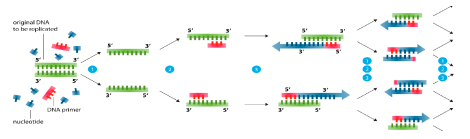
Polymerase chain reaction (PCR) is a laboratory technique used to amplify DNA sequences. The method involves using short DNA sequences called primers to select the portion of the genome to be amplified. The temperature of the sample is repeatedly raised and lowered to help a DNA replication enzyme copy the target DNA sequence. The technique can produce a billion copies of the target sequence in just a few hours.
Image
i. List the three steps involved in Polymerase Chain Reaction (PCR).
ii. Name the source organism of Taq polymerase.
iii. Explain the specific role of this enzyme in PCR.
Double fertilisation is immediately followed by development of endosperm. Explain the link between the two processes.
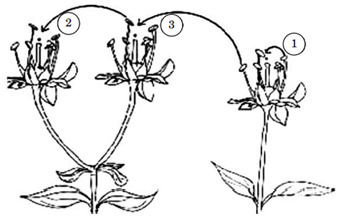
Study the diagram given below showing the modes of pollination. Answer the questions that follow.
Image
i. The given diagram shows three methods of pollen transfer in plants. What are the technical terms used for pollen transfer methods 1, 2 and 3?
ii. How do the following plants achieve pollination successfully?
1. Water lily
2. Vallisneria
iii. Flowering plants have developed many devices to avoid inbreeding depression. Explain one hereditary and one physiological device which helps plants to achieve this target.
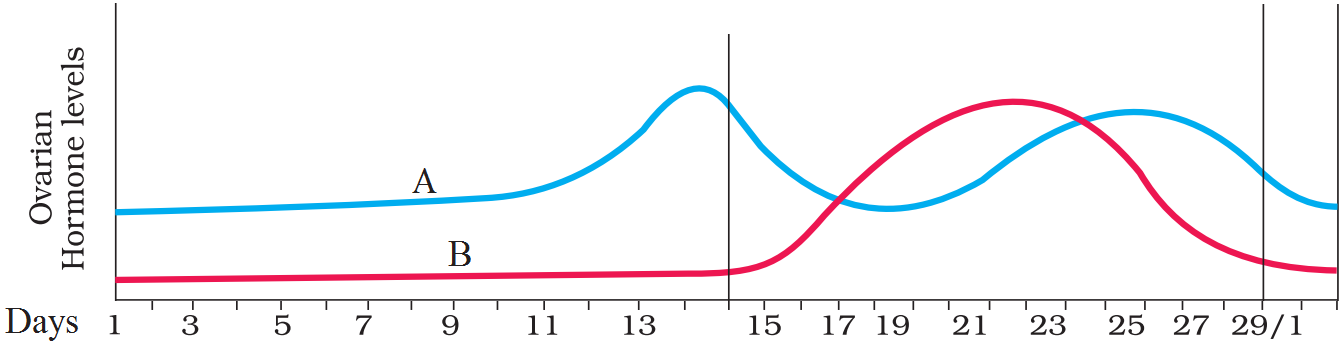
The graph given below shows the variation in the levels of ovarian hormones during various phases of menstrual cycle:

Reason out why A peaks before B.

Samya visited a zoo with her mother, on watching the cheetah, she wondered how he uses his forelimbs for running. While the same forelimbs in bats are used for flying. She wanted to know more about it and so asked her mother (a biology teacher) about it. Her mother explained her how forelimbs are modified in different animal groups for different functions.
  1. What are such organs called?
  2. Give an example of such organs from the plant world.
  3. What led to the origin of such organs?
  4. What are the values shown by Samya?
Answer the following questions:
Draw a diagrammatic sectional view of a human seminiferous tubule, and label Sertoli cells, primary spermatocyte, spermatogonium and spermatozoa in it.