MCQ
A firecracker exploding on the surface of a lake is heard as two sounds a time interval $t$ apart by a man on a boat close to water surface. Sound travels with a speed $u$ in water and a speed $v$ in air. The distance from the exploding firecracker to the boat is
  • A
    $\frac{{uvt}}{{u + v}}$
  • B
    $\frac{{t(u + v)}}{{uv}}$
  • C
    $\frac{{t(u - v)}}{{uv}}$
  • $\frac{{uvt}}{{u - v}}$

Answer

Correct option: D.
$\frac{{uvt}}{{u - v}}$
d
$\mathrm{d}=\mathrm{ut}_{0}$

$\Rightarrow \mathrm{d}=\mathrm{v}\left(\mathrm{t}_{0}+\mathrm{t}\right)$

$\Rightarrow(v-u) t_{0}+v t=0$

$t_{0}=\frac{v t}{u-v}$

$d=\frac{u v t}{u-v}$

Need a full question paper?

Generate a complete, print-ready paper with questions like this in minutes — across 16+ boards, with answer keys.

Start Generating Free

Similar questions

A cube of aluminum of side $0.1m$ is subjected to a shearing force of $100N.$ The top face of the cube is displaced through $0.02\ cm$ with respect to the bottom face. The shearing strain would be:
The efficiency of carnot engine is $50\%$ and temperature of sink is $500\,K$ . If temperature of source is kept constant and its efficiency raised to $60\%$ , then the required temperature of the sink will be  .... $K$
Two masses of $10 \,kg$ and $20 \,kg$ respectivety are connected by a massless spring as shown in fig. A force of $200 \,N$ acts on the $20 \,kg$ mass At the instant shown the $10 \,kg$ mass has acceleration $12 \,m / s ^2$ towards right. The acceleration of $20 \,kg$ mass at this instant is ........ $m / s ^2$
A body, which emits radiations of all possible wavelengths, is known as ...........
The distance $s$ travelled by a particle in time $t$ is $s=u t-\frac{1}{2} \,g t^{2}$. The initial velocity of the particle was measured to be $u=1.11 \pm 0.01 \,m / s$ and the time interval of the experiment was $t=1.01 \pm 0.1 \,s$. The acceleration was taken to be $g=9.8 \pm 0.1 \,m / s ^{2}$. With these measurements, the student estimates the total distance travelled. How should the student report the result?
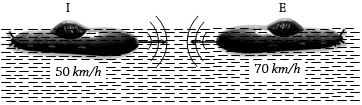
An Indian submarine and an enemy submarine move towards each other during maneuvers in motionless water in the Indian ocean. The Indian submarine moves at $50 km/h$, and the enemy submarine at $70 km/h$. The Indian sub sends out a sonar signal (sound wave in water) at $1000 Hz$. Sonar waves travel at $5500 km/h$. What is the frequency detected by the Indian submarine .... $kHz$
Two heavenly bodies ${S_1}$ and ${S_2}$, not far off from each other are seen to revolve in orbits
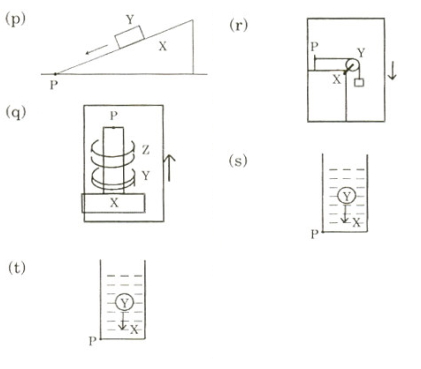
Column $II$ shows five systems in which two objects are labelled as $\mathrm{X}$ and $\mathrm{Y}$. Also in each case a point $\mathrm{P}$ is shown. Column $I$ gives some statements about $\mathrm{X}$ and/or $\mathrm{Y}$. Match these statements to the appropriate system$(s)$ from Column $II$.
Column $I$ Column $II$
$(A)$ The force exerted by $\mathrm{X}$ on $\mathrm{Y}$ has a magnitude $\mathrm{Mg}$. $Image$ Block $Y$ of mass $M$ left on a fixed inclined plane $\mathrm{X}$, slides on it with a constant velocity.
$(B)$ The gravitational potential energy of $\mathrm{X}$ is continuously increasing. $Image$ Two ring magnets $\mathrm{Y}$ and $\mathrm{Z}$, each of mass $M$, are kept in frictionless vertical plastic stand so that they repel each other. $Y$ rests on the base $X$ and $\mathrm{Z}$ hangs in air in equilibrium. $\mathrm{P}$ is the topmost point of the stand on the common axis of the two rings. The whole system is in a lift that is going up with a constant velocity.
$(C)$ Mechanical energy of the system $\mathrm{X}+\mathrm{Y}$ is continuously decreasing. $Image$ A pulley $Y$ of mass $m_0$ is fixed to a table through a clamp $X$. A block of mass $M$ hangs from a string that goes over the pulley and is fixed at point $\mathrm{P}$ of the table. The whole system is kept in a lift that is going down with a constant velocity.
$(D)$ The torque of the weight of $\mathrm{Y}$ about point $\mathrm{P}$ is zero. $Image$ A sphere $\mathrm{Y}$ of mass $M$ is put in a nonviscous liquid $\mathrm{X}$ kept in a container at rest. The sphere is released and it moves down in the liquid.
  $Image$ A sphere $\mathrm{Y}$ of mass $M$ is falling with its terminal velocity in a viscous liquid $\mathrm{X}$ kept in a container.

A particle is projected at $60^o $ to the horizontal with a kinetic energy $K$. The kinetic energy at the highest point is
The Young's Modulus of elasticity is equal to that stress numerically which :