MCQ
A first order reaction was started with a decimolar solution of the reactant, 8 minutes and 20 seconds later its concentration was found to be $M/100$. So the rate of the reaction is
  • A
    $2.303 \times {10^{ - 5}}\;{\sec ^{ - 1}}$
  • B
    $2.303 \times {10^{ - 4}}\;{\sec ^{ - 1}}$
  • $4.606 \times {10^{ - 3}}\;{\sec ^{ - 1}}$
  • D
    $2.606 \times {10^{ - 5}}\;{\sec ^{ - 1}}$
Answer

Correct option: C.
$4.606 \times {10^{ - 3}}\;{\sec ^{ - 1}}$
c
For first order reaction

$K = \frac{{2.303}}{t}\log \frac{a}{{a - x}}$

Given:

$a = \frac{1}{{10}} = .1\,m$;

$a - x = \frac{1}{{100}} = .01\,m$;

$ t = 500 $ $\sec$

$\therefore \;\;K = \frac{{2.303}}{{500}}\log \frac{{.10}}{{.01}} = \frac{{2.303}}{{500}}\log \,10$

$ = \frac{{2.303}}{{500}} = 0.004606 = 4.6 \times {10^{ - 3}}\,{\sec ^{ - 1}}$.

Need a full question paper?

Generate a complete, print-ready paper with questions like this in minutes — across 16+ boards, with answer keys.

Start Generating Free

Similar questions

Which of the following reactions of glucose can be explained only by its cyclic structure?
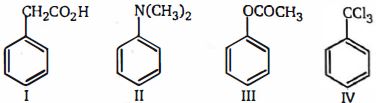
What is the expected order of reactivity of the following compounds in  electrophilic chlorination $(Cl_2 + FeCl_3)$?
(more reactive $>$ less reactive)
The decreasing order of boiling points of the following alcohols is?
The pressure that a single component in a gaseous mixture would exert if it existed alone in the same volume as the mixture and at the same temperature as the mixture is referred to as.
From the following ${E^o}$ values of half cells, what combination of two half cells would result in a cell with the largest potential ?

$\left( I \right)A + {e^ - } \to {A^\circleddash  }\,\,\,\,\,\,{E^o} =  + 0.24\,V$

$\left( {II} \right){B^ - } + {e^ - } \to {B^{ - 2}}\,\,\,\,\,\,{E^o} =  + 1.25\,V$

$\left( {III} \right){C^ - } + 2{e^ - } \to {C^{ - 3}}\,\,\,\,\,\,{E^o} =  + 0.15\,V$

$\left( {IV} \right)D + 2{e^ - } \to {D^{ - 2}}\,\,\,\,\,\,{E^o} =  + 0.68\,V$

How many compounds gives $CO_2$ with $NaHCO_3$ ?
When acetamide reacts with $B{r_2}$ and caustic soda, then we get :
Two $5$ molal solutions are prepared by dissolving a non-electrolyte, non-volatile solute separately in the solvents $X$ and $Y$. The molecular weights of the solvents are $M_X$ and $M_Y$, respectively where $M_X\, = \frac{3}{4} M_Y$. The relative lowering of  vapour pressure of the solution in $X$ is $''m''$ times that of the solution in $Y$. Given that the number of moles of solute is very small in comparison to that of solvent, the value of $''m''$  is
Correct for the complex $[Cu(NH_3)_4]^{2+}$ is/are
Which of the following is planar