MCQ
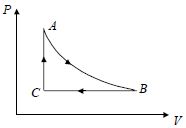
A fixed amount of a gas undergoes a thermodynamic process as shown such that heat interaction along path $B \to C \to A$ is equal to the work done by the gas along path $A \to B \to C$. Then process $A \to B$ is :-
  • A
    can only be isothermal
  • can only be adiabatic
  • C
    can be isothermal or adiabatic
  • D
    none of the above

Answer

Correct option: B.
can only be adiabatic
b
As process is cyclic $\Rightarrow \Delta \mathrm{U}_{\mathrm{ABCA}}=0$

$\Rightarrow \mathrm{Q}_{\mathrm{ABCA}}=\mathrm{W}_{\mathrm{ABCA}}$

$\Rightarrow \mathrm{Q}_{\mathrm{A} \rightarrow \mathrm{B}}+\mathrm{Q}_{\mathrm{B} \rightarrow \mathrm{C}}+\mathrm{Q}_{\mathrm{C} \rightarrow \mathrm{A}}$

$=\mathrm{W}_{\mathrm{A} \rightarrow \mathrm{B}}+\mathrm{W}_{\mathrm{B} \rightarrow \mathrm{C}}+\mathrm{W}_{\mathrm{C} \rightarrow \mathrm{A}}$   $.(1)$

Given $Q_{B \rightarrow C}+Q_{C \rightarrow A}=W_{A \rightarrow B}+W_{B \rightarrow C}$  $(2)$

Subtracting $( 2)$ from $( 1)$

$\mathrm{Q}_{\mathrm{A} \rightarrow \mathrm{B}}=\mathrm{W}_{\mathrm{C} \rightarrow \mathrm{A}}=0$

(as process $\mathrm{C} \rightarrow \mathrm{A}$ is isochoric)

process $A \rightarrow B$ is adiabatic.
Need a full question paper?

Generate a complete, print-ready paper with questions like this in minutes — across 16+ boards, with answer keys.

Start Generating Free

Similar questions

The temperature at which the speed of sound in air becomes double of its value at ${0^o}C$ is  ...... $K$
In an $AC$ circuit the potential differences across an inductance and resistance joined in series are respectively $16\,V$ and $20\,V$. The total potential difference of the source is..........$V$
A porter lifts a heavy suitcase of mass $80\, {kg}$ and at the destination lowers it down by a distance of $80\, {cm}$ with a constant velocity. Calculate the workdone by the porter in lowering the suitcase. (take $g=9.8\, {ms}^{-2}$ ) (In ${J}$)
The ratio of de Broglie wavelength of molecules of hydrogen and helium in two gas jars kept separately at temperatures of $27\,^o C$ and $127\,^oC$ respectively is
A light rod of length $l$ has two masses $m_1$ and $m_2$ attached to its two ends. The moment of inertia of the system about an axis perpendicular to the rod and passing through the centre of mass is 
A vector ${\overrightarrow F _1}$is along the positive $X-$axis. If its vector product with another vector ${\overrightarrow F _2}$ is zero then ${\overrightarrow F _2}$ could be
One insulated conductor from a household extension cord has a mass per unit length of $μ.$ A section of this conductor is held under tension between two clamps. A subsection is located in a magnetic field of magnitude $B$ directed perpendicular to the  length of the cord. When the cord carries an $AC$ current of $"i"$ at a frequency of $f,$ it  vibrates in resonance in its simplest standing-wave vibration state. Determine the  relationship that must be satisfied between the separation $d$ of the clamps and the tension $T$ in the cord.
The activity of a radioactive sample is measured as $N_0$ counts per minute at $t = 0$ and $N_0/e$ counts per minute at $t = 5$ minutes. The time (in minutes) at which the activity reduces to half its value is 
The magnetic flux $\phi$ (in weber) linked with a closed circuit of resistance $8\  \Omega$ varies with time (in seconds) as $\phi=5 t^2-36 t+1$. The induced current in the circuit at $t=2 \mathrm{~s}$ is_____ A.
While capturing solar energy for commercial purposes we use