MCQ
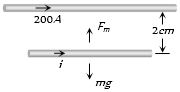
A fixed horizontal wire carries a current of $200\, A$. Another wire having a mass per unit length ${10^{ - 2}}\,kg/m$ is placed below the first wire at a distance of $2\, cm$ and parallel to it. How much current must be passed through the second wire if it floats in air without any support? What should be the direction of current in it
  • A
    $25\,A$ (direction of current is same to first wire)
  • B
    $25\,A$ (direction of current is opposite to first wire)
  • $49\, A$ (direction of current is same to first wire)
  • D
    $49\, A$ (direction of current is opposite to first wire)
Answer

Correct option: C.
$49\, A$ (direction of current is same to first wire)
c
(c) For floating the second wire
$\left| \begin{array}{l}\,{\rm{Down}}\;{\rm{ward}}\;{\rm{weight}}\,\\\;\;{\rm{of}}\;{\rm{second}}\;{\rm{wire}}\end{array} \right| = \left| \begin{array}{l}\,{\rm{Magnetic}}\;{\rm{force}}\,\\\;\;\;\;\;{\rm{on}}\;{\rm{it}}\end{array} \right|$
$ \Rightarrow mg = \frac{{{\mu _0}}}{{4\pi }}.\frac{{2{i_1}{i_2}}}{a} \times l$
$ \Rightarrow \left( {\frac{m}{l}} \right)g = \frac{{{\mu _0}}}{{4\pi }}.\frac{{2{i_1}{i_2}}}{a}$
$ \Rightarrow {10^{ - 2}} \times 9.8 = {10^{ - 7}} \times \frac{{2 \times 200 \times i}}{{2 \times {{10}^{ - 2}}}} \Rightarrow i = 49\,A$
(Direction of current is same to first wire)

Need a full question paper?

Generate a complete, print-ready paper with questions like this in minutes — across 16+ boards, with answer keys.

Start Generating Free

Similar questions

In the adjoining circuit, the galvanometer $G$ shows zero deflection. If the batteries $A$ and $B$ have negligible internal resistance, the value of the resistor $R$ will be .............. $\Omega$
A double convex lens of glass of m = 1.5 has radius of curvature of each of its surface is 0.2 m. The power of the lens is
The process by which $ac$ is converted into $dc$ is known as
The figure below is the plot of potential energy versus internuclear distance $(d)$ of $H _2$ molecule in the electronic ground state. What is the value of the net potential energy $E_0$ (as indicated in the figure) in $kJ mol ^{-1}$, for $d=d_0$ at which the electron-electron repulsion and the nucleus-nucleus repulsion energies are absent? As reference, the potential energy of $H$ atom is taken as zero when its electron and the nucleus are infinitely far apart.

Use Avogadro constant as $6.023 \times 10^{23} mol ^{-1}$.

A nucleus of mass 218 amu in free state decays to emit an a-particle. Kinetic energy of the a-particle emitted is 6.7 MeV. The recoil energy (in MeV) of the daughter nucleus is
The shape of wave front at a very large distance from source is $........$
The unit of electric field is not equivalent to:
$A$ curved surface of radius $R$ separates two medium of refractive indices $\mu_1$ and $\mu_2$ as shown in figures $A$ and $B$ Choose the correct statement $(s)$ related to the virtual image formed by object $O$ placed at a distance $x$, as shown in figure $A$
Huygen’s principle of secondary wavelets may be used to
Dimensions of a block are $1\,cm \times 1\,cm \times 100\,cm$. If specific resistance of its material is $3 \times {10^{ - 7}}\,ohm - m$, the resistance between the square faces is