Question

A flat circular disc has a charge +Q uniformly distributed on the disc. A charge +q is thrown with kinetic energy  E towards the disc along its normal axis. The charge q  will

(a) Hit the disc at the centre

(b) Return back along its path after touching the disc

(c) Return back along its path without touching the disc

(d) Any of the above three situations is possible depending on the magnitude of E

Answer

(d) Any of the above three situations is possible depending on the magnitude of E

Need a full question paper?

Generate a complete, print-ready paper with questions like this in minutes — across 16+ boards, with answer keys.

Start Generating Free

Similar questions

A positive charge Q is uniformly distributed along a circular ring of radius R.A. small test charge q is placed at the centre of the ring Fig. Then:
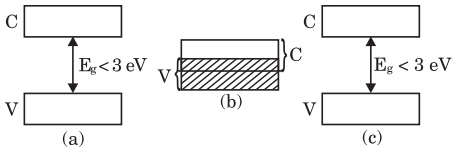
Energy Bands of three substances are shown in the following figures, where V is valance band and C is conduction band.
Image
These substances respectively are :

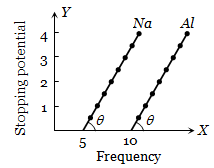
From the figure describing photoelectric effect we may infer correctly that         

(a) Na and Al both have the same threshold frequency

(b) Maximum kinetic energy for both the metals depend linearly on the frequency

(c) The stopping potentials are different for Na and Al for the same change in frequency

(d) Al is a better photo sensitive material than Na

Cutoff wavelength of X-rays coming from a Coolidge tube depends on the:

The magnetic field due to a current carrying circular loop of radius 3 cm at a point on the axis at a distance of 4 cm from the centre is 54 mT. What will be its value at the centre of the loop

(a) 250 m T

(b) 150 m T

(c) 125 m T

(d) 75 m T

Bonds in semiconductors are :

The potential difference applied to an X-ray tube is increased. As a result, in the emitted radiation

(a) The intensity increases

(b) The minimum wavelength increases

(c) The intensity decreases

(d) The minimum wavelength decreases

Assertion  :   The tyres of aircraft's are slightly conducting.

Reason      : If a conductor is connected to ground, the extra charge induced on conductor will flow to ground.

(a) If both assertion and reason are true and the reason is the correct explanation of the assertion.

(b) If both assertion and reason are true but reason is not the correct explanation of the assertion.

(c) If assertion is true but reason is false.

(d) If the assertion and reason both are false.

A dip circle is so set that its needle moves freely in the magnetic meridian. In this position, the angle of dip is 40º. Now the dip circle is rotated so that the plane in which the needle moves makes an angle of 30º with the magnetic meridian. In this position, the needle will dip by an angle:

In determining the temperature of a distant star, one makes use of

(a) Kirchhoff's law

(b) Stefan's law

(c) Wien's displacement law

(d) None of these