MCQ
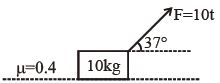
A force acts on a block as shown in figure. Find time when block loses contact with surface.
  • A
    $t = 25/3 \, \sec$
  • $t = 50/3 \, \sec$
  • C
    $t = 100/3 \, \sec$
  • D
    $t = 50 \, \sec$

Answer

Correct option: B.
$t = 50/3 \, \sec$
b
$\mathrm{N}=\mathrm{F} \sin 37^{\circ}-\mathrm{mg}$

as per given condition

When $\mathrm{N}=0 \quad \mathrm{F} \sin 37^{\circ}-\mathrm{mg}=0$

$\Rightarrow F \sin 37^{\circ}=\mathrm{mg}$

$\Rightarrow 10 t \times \frac{3}{5}=10 \times 10 \Rightarrow t=\frac{50}{3} \mathrm{s}$

Need a full question paper?

Generate a complete, print-ready paper with questions like this in minutes — across 16+ boards, with answer keys.

Start Generating Free

Similar questions

The earth is assumed to be a sphere of radius $R.$ A platform is arranged at a height $R$ from the surface of the earth. The escape velocity of a body from this platform is $fv$, where $v$ is its escape velocity from the surface of the Earth. The value of $f$ is
A block of mass $M$ is being pulled along rough horizontal surface. The coefficient of friction between the block and the surface is $\mu $. If another block of mass $M/2$ is placed on the block and it is again pulled on the surface, the coefficient of friction between the block and the surface will be
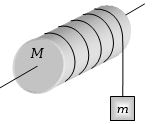
A mass $M$ is supported by a mass less string would wound a uniform cylinder of mass $M$ and radius $R$. On releasing the mass from rest, it will fall with acceleration
Two identical p-ri junctions may be connected in series with a battery in three ways (figure). The potential difference across the two p-n. junctions are equal in:
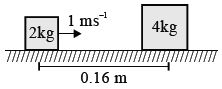
The friction coefficient between the horizontal surface and each of the block shown in  figure is $0.2.$ The collision between the blocks is perfectly elastic. What is the  separation between the blocks when they come to rest :- .............. $\mathrm{cm}$
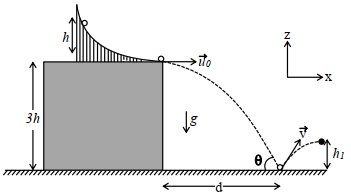
A slide with a frictionless curved surface, which becomes horizontal at its lower end,, is fixed on the terrace of a building of height $3 h$ from the ground, as shown in the figure. A spherical ball of mass $\mathrm{m}$ is released on the slide from rest at a height $h$ from the top of the terrace. The ball leaves the slide with a velocity $\vec{u}_0=u_0 \hat{x}$ and falls on the ground at a distance $d$ from the building making an angle $\theta$ with the horizontal. It bounces off with a velocity $\overrightarrow{\mathrm{v}}$ and reaches a maximum height $h_l$. The acceleration due to gravity is $g$ and the coefficient of restitution of the ground is $1 / \sqrt{3}$. Which of the following statement($s$) is(are) correct?

($AV$) $\vec{u}_0=\sqrt{2 g h} \hat{x}$ ($B$) $\vec{v}=\sqrt{2 g h}(\hat{x}-\hat{z})$  ($C$) $\theta=60^{\circ}$  ($D$) $d / h_1=2 \sqrt{3}$
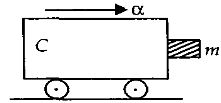
A block of mass $m$ is in contact with the cart $C$ as shown in the figure. The coefficient of static friction between the block and the cart is $\mu .$ The acceleration $\alpha$ of the cart that will prevent the block from falling satisfies
If the law of gravitation, instead of being inversesquare law, becomes an inversecube law.
  1. Planets will not have elliptic orbits.
  2. Circular orbits of planets is not possible.
  3. Projectile motion of a stone thrown by hand on the surface of the earth will be approximately parabolic.
  4. There will be no gravitational force inside a spherical shell of uniform density.
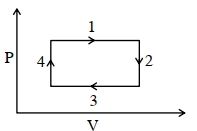
An ideal gas undergoes a four step cycle as shown in the $P-V$ diagram below. During this cycle, in which step heat is absorbed by the gas
From a circular ring of mass $'\mathrm{M}'$ and radius $'R'$ an arc corresponding to a $90^{\circ}$ sector is removed. The moment of inertia of the remaining part of the ring about an axis passing through the centre of the ring and perpendicular to the plane of the ring is $'K'$ times $\mathrm{MR}^{2}.$ Then the value of $'\mathrm{K}'$ is