MCQ
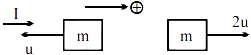
$A$ force exerts an impulse $I$ on a particle changing its speed from $u$ to $2u$. The applied force and the initial velocity are oppositely directed along the same line. The work done by the force is
  • A
    $\frac{3}{2}{\text{I}}\,{\text{u}}$
  • $\frac{1}{2}{\text{I}}\,{\text{u}}$
  • C
    $I \,u$
  • D
    $2\, I\, u$

Answer

Correct option: B.
$\frac{1}{2}{\text{I}}\,{\text{u}}$
b
$\mathrm{I}=\Delta \mathrm{P}$

$\mathrm{I}=2 \mathrm{mu}-(-\mathrm{mu})$

$\mathrm{I}=3 \mathrm{mu} \ldots(\mathrm{i})$

According to work energy theorem

$\mathrm{W}=\Delta \mathrm{T}$

$\mathrm{W}=\mathrm{T}_{\mathrm{f}}-\mathrm{T}_{\mathrm{i}}$

$\mathrm{W}=\frac{1}{2} \mathrm{m}(2 \mathrm{u})^{2}-\frac{1}{2} \mathrm{m}(-\mathrm{u})^{2}$

$\mathrm{W}=\frac{1}{2} \mathrm{m}\left(4 \mathrm{u}^{2}\right)-\frac{1}{2} \mathrm{mu}^{2}$

$\mathrm{w}=\frac{3 \mathrm{mu}^{2}}{2}$         $...(ii)$

From equation $(i)$ and $(ii)$

$\mathrm{W}=\frac{1}{2} \mathrm{Iu}$

Need a full question paper?

Generate a complete, print-ready paper with questions like this in minutes — across 16+ boards, with answer keys.

Start Generating Free

Similar questions

An iron block is dropped into a deep well. Sound of splash is heard after $4.23 \,s$. If the depth of the well is $78.4 \,m$, then find the speed of sound in air is ............ $m / s$ $\left(g=9.8 \,m / s ^2\right)$
A heavy iron bar of weight $12 \mathrm{~kg}$ is having its one end on the ground and the other on the shoulder of a man. The rod makes an angle $60^{\circ}$ with the horizontal, the weight experienced by the man is :
A body of mass $m $ is attached to the lower end of a spring whose upper end is fixed. The spring has negligible mass. When the mass $m$ is slightly pulled down and released , it oscillates with a time period of $3\,s$ . When the mass $m$ is increased by $1\,kg$ , the time period of oscillations becomes $5\,s$ . The value of $m$ in $kg$ is
Pressure inside two soap bubbles are $1.02 \,atm$ and $1.05 \,atm$ respectively. The ratio of their surface area is .........
The displacement of the wave given by equation $\text{y (x, t)}=\text{a}\sin(\text{kx}-\omega\text{t}+\phi),$ where $\phi = 0$ at point $x$ and $t = 0$ is same as that at point:
If dimensions of critical velocity $v_c$ of a liquid flowing through a tube are expressed as$ [\eta ^x \rho ^yr^z]$ where  $\eta ,\rho $ and $r $ are the coefficient of viscosity of liquid, density of liquid and radius of the tube respectively, then the values of $x, y$ and $z$ are given by
The factor not needed to calculate heat lost or gained when there is no change of state is
Let $F_{p p}, F_{p n}$ and $F_{n n}$ denote the magnitudes of the net force by a proton on a proton, by a proton on a neutron and by a neutron on a neutron respectively. Neglect gravitational force. When the separation is $1 fm :$
A man is running at a speed of $5\, m/s$, the rain drops appear to be falling at an angle of $45^o$ from the vertical. If the rain drops are actually falling vertically downwards, then velocity of rain drops (in $m/s$) is
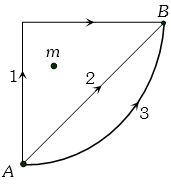
If ${W_1},\,{W_2}$ and ${W_3}$ represent the work done in moving a particle from $A$ to $B$ along three different paths $1, 2$ and $3$ respectively (as shown) in the gravitational field of a point mass m, find the correct relation between ${W_1},\,{W_2}$ and ${W_3}$