MCQ
A force $F$ is needed to break a copper wire having radius $R.$ The force needed to break a copper wire of radius $2R$ will be
  • A
    $F/2$
  • B
    $2F$
  • $4F$
  • D
    $F/4$

Answer

Correct option: C.
$4F$
c
(c) Breaking Force $\propto$ Area of cross section of wire ($\pi r^2$)

If radius of wire is double then breaking force will become four times.

Need a full question paper?

Generate a complete, print-ready paper with questions like this in minutes — across 16+ boards, with answer keys.
Start Generating Free

Similar questions

The area of each plate of a parallel plate capacitor is $100\,c{m^2}$and the distance between the plates is $1\,mm$. It is filled with mica of dielectric $6$. The radius of the equivalent capacity of the sphere will be.......$m$
Assuming the earth to be a sphere of uniform density the acceleration due to gravity
The dimensions of $C{V^2}$ matches with the dimensions of
An uniform thin rod of length $2 L$ and mass $m$ lies on a horizontal table. A horizontal impulse $J$ is given to the rod at one end. There is no friction. The total kinetic energy of the rod just after the impulse will be
Standing waves are generated on a sonometer string loaded with a cylindrical body. If the cylinder is completely immersed in water, the length of the loops changes by a factor of $2.2$ . The specific gravity of the material of the cylinder is 
$B _{ X }$ and $B _{ Y }$ are the magnetic field at the centre of two coils of two coils $X$ and $Y$ respectively, each carrying equal current. If coil $X$ has $200$ turns and $20 cm$ radius and coil $Y$ has $400$ turns and $20 cm$ radius, the ratio of $B _{ X }$ and $B _{ Y }$ is
The pressure acting on a submarine is $3 \times 10^{5}\;Pa$ at a certain depth. If the depth is doubled, the percentage increase in the pressure acting on the submarine would be: (Assume that atmospheric pressure is $1 \times 10^{5} \;Pa$ density of water is $10^{3}\, kg \,m ^{-3}, g =10 \,ms ^{-2}$ )
The initial velocity of a projectile is $\vec u = (4\hat i + 3\hat j)\,m/s$ it is moving with uniform acceleration $\vec a = (0.4\hat i + 0.3\hat j)\, m/s^2$ The magnitude of its velocity after $10\,s$ is.........$m/s$
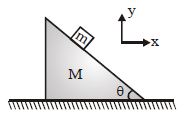
Consider the shown arrangement. Assume all surfaces to be smooth. If $N$ represents magnitudes of normal reaction between block and wedge, then acceleration of $M$ along horizontal equals
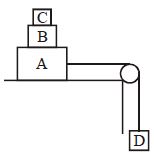
Three blocks $A$, $B$ and $C$ of equal mass $m$ are placed on a smooth surface as shown. Coefficient of friction between any block $A, B$ and $C$ is $μ$. The maximum value of mass $D$ so the block $A, B$ & $C$ move without slipping over each other is