MCQ
A force $\text{F}=-\text{kx}^2(\text{x}\neq0)$ acts on a particle in $X-$direction. Find the work done by the force in displacing the particle from $x = -a$ to $x = 2a.$
  • $\frac{3\text{k}}{2\text{a}}$
  • B
    $\frac{4\text{k}}{\text{a}^2}$
  • C
    $\frac{-3\text{k}}{2\text{a}^2}$
  • D
    $\frac{-9\text{k}}{\text{a}^2}$

Answer

Correct option: A.
$\frac{3\text{k}}{2\text{a}}$

Need a full question paper?

Generate a complete, print-ready paper with questions like this in minutes — across 16+ boards, with answer keys.

Start Generating Free

Similar questions

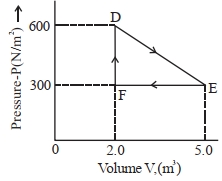
A thermodynamic system is taken from an original state $D$ to an intermediate state $E$ by the linear process shown in the figure. Its volume is then reduced to the original volume from $E$ to $F$ by an isobaric process. The total work done by the gas from $D$ to $E$ to $F$ will be $......J$
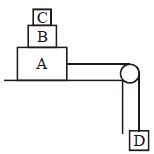
Three blocks $A$, $B$ and $C$ of equal mass $m$ are placed on a smooth surface as shown. Coefficient of friction between any block $A, B$ and $C$ is $μ$. The maximum value of mass $D$ so the block $A, B$ & $C$ move without slipping over each other is
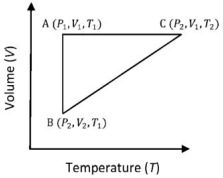
A reversible cyclic process for an ideal gas is shown below. Here, $P , V$, and $T$ are pressure, volume and temperature, respectively. The thermodynamic parameters $q, w, H$ and $U$ are heat, work, enthalpy and internal energy, respectively.

The correct option ($s$) is (are)

$(A)$ $q_{A C}=\Delta U_{B C}$ and $W_{A B}=P_2\left(V_2-V_1\right)$ $(B)$ $W _{ BC }= P _2\left( V _2- V _1\right)$ and $q _{ BC }= H _{ AC }$ $(C)$ $\Delta H _{ CA }<\Delta U _{ CA }$ and $q _{ AC }=\Delta U _{ BC }$ $(D)$ $q_{B C}=\Delta H_{A C}$ and $\Delta H_{C A}>\Delta U_{C A}$

A spherical black body with a radius of $24\;cm$ radiates $440\;W$ power at $500\;K$. If the radius were halved and the temperature doubled, the power radiated in watt would be
Correct formula for height of a satellite from earths surface is :
The couple of tuning forks produces $2$ beats in the time interval of $0.4$ seconds. So the beat frequency is .... $Hz$
A missile is fired for maximum range at your town from a place $100\, km$ away from you. If the missile is first detected at its half way point, how much warning time will you have ? (Take $g = 10\, m/s^2$) what was the speed of missile when it was detected ?
The workdone by a gas molecule in an isolated system is given by, $W =\alpha \beta^{2} e ^{-\frac{ x ^{2}}{\alpha kT }},$ where $x$ is the displacement, $k$ is the Boltzmann constant and $T$ is the temperature, $\alpha$ and $\beta$ are constants. Then the dimension of $\beta$ will be
$Assertion$ : $n$ small balls each of mass $m$ colliding elastically each second on surface with velocity $u$. The force experienced by the surface is $2\,mnu$.

$Reason$ : On elastic collision, the ball rebounds with the same velocity.

If $I_1$ is the moment of inertia of a thin rod about an axis perpendicular to its length and passing through its centre of mass, and $I_2$ is the moment of inertia of the ring formed by bending the rod, then