MCQ
A force vector applied on a mass is represented as $\vec F = 6\hat i - 8\hat j + 10\hat k$ and accelerates with $1\;m/{s^2}$. What will be the mass of the body in $kg$.
  • $10\sqrt 2 $
  • B
    $20$
  • C
    $2\sqrt {10} $
  • D
    $10$

Answer

Correct option: A.
$10\sqrt 2 $
a
(a) ${\rm{Mass}} = \frac{{{\rm{Force}}}}{{{\rm{Acceleration}}}} = \frac{{|\vec F|}}{a}$

= $\frac{{\sqrt {36 + 64 + 100} }}{1}$$ = 10\sqrt 2 \;kg$

Need a full question paper?

Generate a complete, print-ready paper with questions like this in minutes — across 16+ boards, with answer keys.
Start Generating Free

Similar questions

Aboat having a speed of $5\,\, km/hr$. in still water, crosses a river of width $1\,\, km$ along the shortest possible path in $15 \,\,minutes$. The speed of the river in $Km/hr.$
If mass is written as $\mathrm{m}=\mathrm{kc}^{\mathrm{p}} \mathrm{G}^{-1 / 2} \mathrm{~h}^{1 / 2}$ then the value of $P$ will be : (Constants have their usual meaning with $\mathrm{k}$ a dimensionless constant)
Four particles each of mass $m$ are placed at the vertices of a square of side $l.$ The potential energy of the system is
Which of the following is not the property of an ideal fluid?
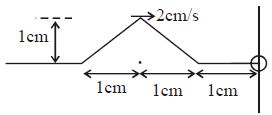
A trianguler pulse moving at $2\ cm/s$ on a rope approches an end at which it is free to slide on vertical pole. What is the particle speed at the free end at $\frac{3}{4}\  sec$  from the instant shown ...... $cm/s$
A body is thrown vertically upwards with a velocity of $19.6\, ms^{-1}$. The position of the body after $4\, s $ will be
For a particle in a non-uniform accelerated circular motion
In an isothermal reversible expansion, if the volume of $96\, gm$ of oxygen at $27°C$ is increased from $70$ litres to $140$ litres, then the work done by the gas will be
A rocket has an initial mass of $20 \times {10^3}\,kg$. If it is to blast off with an initial acceleration of $4\,m{s^{ - 2}}$, the initial thrust needed is  $(g = 10\,m{s^{ - 2}})$
A clock $S$ is based on oscillation of a spring and a clock $ P$ is based on pendulum motion. Both clocks run at the same rate on earth. On a planet having the same density as earth but twice the radius