MCQ
A free hydrogen atom after absorbing a photon of wavelength $\lambda_{ a }$ gets excited from the state $n =1$ to the state $n =4$. Immediately after that the electron jumps to $n=m$ state by emitting a photon of wavelength $\lambda_{\text {. }}$. Let the change in momentum of atom due to the absorption and the emission are $\Delta p_2$, and $\Delta p_\theta$, respectively. If $\lambda_2 / \lambda_0=\frac{1}{5}$. Which of the option(s) is/are correct ?

[Use $hc =1242 eV nm ; 1 nm =10^{-9} m , h$ and $c$ are Planck's constant and speed of light, respectively]

$(1)$ $\lambda_0=418 nm$

$(2)$ The ratio of kinetic energy of the electron in the state $n = m$ to the state $n =1$ is $\frac{1}{4}$

$(3)$ $m =2$

$(4)$ $\Delta p_{ a } / \Delta p _{ o }=\frac{1}{2}$

  • $2,3$
  • B
    $2,4$
  • C
    $3,2$
  • D
    $1,3$

Answer

Correct option: A.
$2,3$
a
$\frac{ hc }{\lambda_{ a }}=13.6\left[\frac{1}{1}-\frac{1}{4^2}\right]$   $. . . . . . .(1)$

$\frac{ hc }{\lambda_0}=13.6\left[\frac{1}{ m ^2}-\frac{1}{4^2}\right]$  $. . . . . . .(1)$

$(ii) / (i),$ we get

$\frac{\lambda_{ a }}{\lambda_0}=\frac{\left[\frac{1}{ m ^2}-\frac{1}{16}\right]}{\left[1-\frac{1}{16}\right]}=\frac{1}{5}$

$\Rightarrow \frac{1}{ m ^2}-\frac{1}{16}=\frac{15}{16} \times \frac{1}{5}$

$\Rightarrow \frac{1}{ m ^2}-\frac{1}{16}=\frac{3}{16}$

$\Rightarrow \frac{1}{ m ^2}=\frac{3}{16}+\frac{1}{16}$

$\Rightarrow m =2$

from $(ii)$

$\frac{ hc }{\lambda_0}=13.6\left[\frac{1}{2^2}-\frac{1}{4^2}\right]=13.6 \times \frac{3}{10} ev$

$\Rightarrow \lambda_0=\frac{12400 \times 16}{13.6 \times 3} \mathring A$

$\Rightarrow \lambda_0 \approx 4862 \mathring A$

we have $K E_u \propto \frac{z^2}{n^2}$

$\Rightarrow \frac{ KE _2}{ KE _1}=\frac{1}{4}$

$\Delta P _{ a }=\frac{ h }{\lambda_{ a }}$

$\Delta P _0=\frac{ h }{\lambda_0}$

$\Rightarrow \frac{\Delta P _{ a }}{\Delta P }=\frac{\lambda_0}{\lambda}$

Need a full question paper?

Generate a complete, print-ready paper with questions like this in minutes — across 16+ boards, with answer keys.

Start Generating Free

Similar questions

The maximum vertical distance through which a fully dressed astronaut can jump on the earth is $0.5\, m$. If mean density of the moon is two-thirds that of the earth and radius is one quarter that of the earth, the maximum vertical distance through which he can jump on the moon and the ratio of time of duration of jump on the moon to that on the earth are
Two discs of moment of inertia $I_1=4 \mathrm{~kg} \mathrm{~m}^2$ and $\mathrm{I}_2=2 \mathrm{~kg} \mathrm{~m}^2$ about their central axes & normal to their planes, rotating with angular speeds $10 \mathrm\ {rad} / \mathrm{s}$ & $4  \mathrm\ {rad} / \mathrm{s}$ respectively are brought into contact face to face with their axe of rotation coincident. The loss in kinetic energy of the system in the process is____ $\mathrm{J}$.
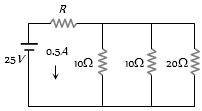
In the circuit as shown in figure the
A body of mass $1\, kg$ is moving in a vertical circular path of radius $1\,m$. The difference between the kinetic energies at its highest and lowest position is ......... $J$
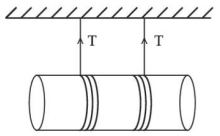
A solid cylinder length is suspended symmetrically through two massless strings, as shown in the figure. The distance from the initial rest position, the cylinder should by unbinding the strings to achieve a speed of $4\,ms ^{-1}$, is$........cm$. $\left(\right.$ take $\left.g=10\,ms ^{-2}\right)$
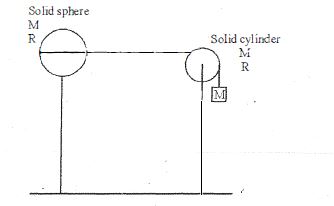
A solid sphere rotates about a vertical axis on frictionless bearing. A massless cord passes around the equator of sphere, then passes through over a solid cylinder and then is connected to block of mass $M$ as  shown in figure. If the system is released from rest then the speed acquired by block after it has fallen through distance $h$ is
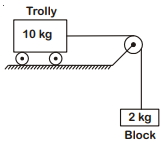
Calculate the acceleration (In $m/s^{2}$) of the block and trolly system shown in the figure. The coefficient of kinetic friction between the trolly and the surface is $0.05 .\left( g =10\; m / s ^{2},\right.$ mass of the string is negligible and no other friction exists).
In ballistic galvanometer, the frame on which the coil is wound is non-metallic to
A bird sitting on a single high tension wire does not get electrocuted because
A man grows into a giant such that his linear dimensions increase by a factor of $9$. Assuming that his density remains same, the stress in the leg will change by a factor of