MCQ
A freely suspended magnet aligns in which direction?
  • A
    South$-$west
  • B
    East$-$west
  • North$-$south
  • D
    North$-$west

Answer

Correct option: C.
North$-$south
A freely suspended magnet aligns in north$-$south direction.

Need a full question paper?

Generate a complete, print-ready paper with questions like this in minutes — across 16+ boards, with answer keys.

Start Generating Free

Similar questions

What is the angle between the electric dipole moment and the electric field strength due to it on the equatorial line......$^o$
A nucleus disintegrates into two smaller parts, which have their velocities in the ratio $3: 2$. The ratio of their nuclear sizes will be $\left(\frac{x}{3}\right)^{\frac{1}{3}}$. The value of ' $x$ ' is :
A resistance of $300$ $\omega$ and an inductance of $\frac{1}{\pi }$ henry are connected in series to a $ac$ voltage of $20 \,volts$ and $200 \,Hz$ frequency. The phase angle between the voltage and current is
Tungsten has work function $4.8\ eV$. We wish to use tungsten as photo$-$cathode with a $600\ nm$ wavelength. What shall we do?
A parallel plate capacitor is charged to a certain potential and the charging battery is then disconnected. Now, if the plates of the capacitor are moved apart then:
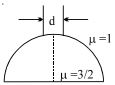
$A$ beam of diameter $‘d’$ is incident on a glass hemisphere as shown. If the radius of curvature of the hemisphere is very large in comparison to $d$, then the diameter of the beam at the base of the hemisphere will be:
A cube of a metal is given a positive charge Question: For this system, which of the following statements is true?
If the ratio of the concentration of electrons to that of holes in a semiconductor is$\frac{7}{5}$ and the ratio of currents is $\frac{7}{4}$ then what is the ratio of their drift velocities?
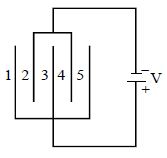
Five similar condenser plates, each of area $A$, are placed at equal distance apart and are  connected to a source of $e.m.f.$ $V$ as shown in the following diagram. The charge on the  plates $1$ and $4$ will be:-
Two resistances equal at $0\,^oC$ with temperature coefficient of resistance $\alpha _1$ and $\alpha _2$ joined in series act as a single resistance in a circuit. The temperature coefficient of their single resistance will be